


Page 213 - HOW TO PROVE IT: A Structured Approach, Second Edition
P. 213
P1: PIG/  P2: OYK/
                   0521861241c04  CB996/Velleman  October 20, 2005  2:54  0 521 86124 1  Char Count= 0


                                                   Ordering Relations                  199
                              We end this section by looking once again at how these new concepts apply
                            to the subset partial order on P (A), for any set A. It turns out that in this partial
                            order, least upper bounds and greatest lower bounds are our old friends unions
                            and intersections.

                            Theorem 4.4.11. Suppose A is a set, F ⊆ P (A), and F  = ∅. Then the least
                            upper bound of F (in the subset partial order) is ∪F and the greatest lower
                            bound of F is ∩F.
                            Proof. See exercise 23.


                                                       Exercises

                            ∗
                             1. In each case, say whether or not R is a partial order on A. If so, is it a total
                                order?
                                (a) A ={a, b, c}, R ={(a, a), (b, a), (b, b), (b, c), (c, c)}.
                                (b) A = R, R ={(x, y) ∈ R × R || x |≤| y |}.
                                (c) A = R, R ={(x, y) ∈ R × R || x | < | y | or x = y}.
                             2. In each case, say whether or not R is a partial order on A. If so, is it a total
                                order?
                                (a) A = the set of all words of English, R ={(x, y) ∈ A × A | the word
                                   y occurs at least as late in alphabetical order as the word x}.
                                (b) A = the set of all words of English, R ={(x, y) ∈ A × A | the first
                                   letter of the word y occurs at least as late in the alphabet as the first
                                   letter of the word x}.
                                (c) A = the set of all countries in the world, R ={(x, y) ∈ A × A | the
                                   population of the country y is at least as large as the population of the
                                   country x}.
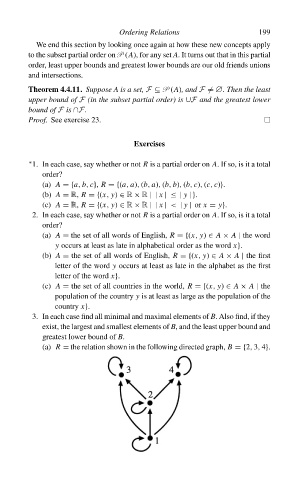
                             3. In each case find all minimal and maximal elements of B. Also find, if they
                                exist, the largest and smallest elements of B, and the least upper bound and
                                greatest lower bound of B.
                                (a) R = the relation shown in the following directed graph, B ={2, 3, 4}.

