


Page 228 - HOW TO PROVE IT: A Structured Approach, Second Edition
P. 228
P1: PIG/  P2: OYK/
                   0521861241c04  CB996/Velleman  October 20, 2005  2:54  0 521 86124 1  Char Count= 0


                                   214                        Relations
                                   the same birthday as q and q has the same birthday as r, then p has the same
                                   birthday as r,so B is transitive. Therefore B is an equivalence relation.
                                     It may be instructive to look at the relation B more closely. We can think
                                   of this relation as splitting the set P of all people into 366 categories, one for
                                   each possible birthday. (Remember, some people were born on February 29th!)
                                   An ordered pair of people will be an element of B if the people come from the
                                   same category, but will not be an element of B if the people come from different
                                   categories. We could think of these categories as forming a family of subsets of
                                   P, which we could write as an indexed family as follows. First of all, let D be
                                   the set of all possible birthdays. In other words, D ={Jan. 1, Jan. 2, Jan. 3, . . . ,
                                   Dec. 30, Dec. 31}. Now for each d ∈ D, let P d ={p ∈ P | the person p was
                                   born on the day d}. Then the family F ={P d | d ∈ D} is an indexed family of
                                   subsets of P. The elements of F are called equivalence classes for the relation
                                   B, and every person is an element of exactly one of these equivalence classes.
                                   The relation B consists of those pairs (p, q) ∈ P × P such that the people p
                                   and q are in the same equivalence class. In other words,

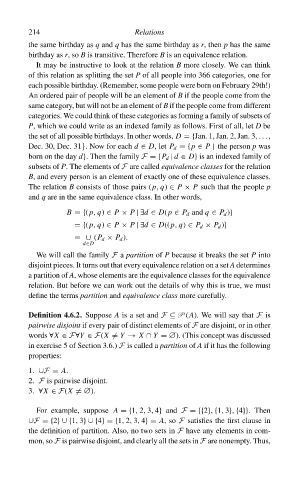
                                            B ={(p, q) ∈ P × P |∃d ∈ D(p ∈ P d and q ∈ P d )}
                                              ={(p, q) ∈ P × P |∃d ∈ D((p, q) ∈ P d × P d )}
                                              = ∪ (P d × P d ).
                                                d∈D
                                     We will call the family F a partition of P because it breaks the set P into
                                   disjoint pieces. It turns out that every equivalence relation on a set A determines
                                   a partition of A, whose elements are the equivalence classes for the equivalence
                                   relation. But before we can work out the details of why this is true, we must
                                   define the terms partition and equivalence class more carefully.

                                   Definition 4.6.2. Suppose A is a set and F ⊆ P (A). We will say that F is
                                   pairwise disjoint if every pair of distinct elements of F are disjoint, or in other
                                   words ∀X ∈ F∀Y ∈ F(X  = Y → X ∩ Y = ∅). (This concept was discussed
                                   in exercise 5 of Section 3.6.) F is called a partition of A if it has the following
                                   properties:

                                   1. ∪F = A.
                                   2. F is pairwise disjoint.
                                   3. ∀X ∈ F(X  = ∅).

                                     For example, suppose A ={1, 2, 3, 4} and F ={{2}, {1, 3}, {4}}. Then
                                   ∪F ={2}∪{1, 3}∪{4}={1, 2, 3, 4}= A,so F satisfies the first clause in
                                   the definition of partition. Also, no two sets in F have any elements in com-
                                   mon, so F is pairwise disjoint, and clearly all the sets in F are nonempty. Thus,

