


Page 233 - HOW TO PROVE IT: A Structured Approach, Second Edition
P. 233
P1: PIG/  P2: OYK/
                   0521861241c04  CB996/Velleman  October 20, 2005  2:54  0 521 86124 1  Char Count= 0


                                                  Equivalence Relations                219
                            Clearly for different choices of F we will need to choose R differently, so
                            the definition of R should depend on F in some way. Looking back at the
                            same-birthday example may help you see how to proceed. Recall that in that
                            example the equivalence relation B consisted of all pairs of people (p, q) such
                            that p and q were in the same set in the partition {P d | d ∈ D}. In fact, we
                            found that we could also express this by saying that B =∪ d∈D (P d × P d ). This
                            suggests that in the proof of Theorem 4.6.6 we should let R be the set of all
                            pairs (x, y) ∈ A × A such that x and y are in the same set in the partition F.
                            An alternative way to write this would be R =∪ X∈F (X × X).
                              For example, consider again the example of a partition given after Definition
                            4.6.2. In that example we had A ={1, 2, 3, 4} and F ={{2}, {1, 3}, {4}}.Now
                            let’s define a relation R on A as suggested in the last paragraph. This gives us:
                                      R = ∪ (X × X)
                                          X∈F
                                        = ({2}×{2}) ∪ ({1, 3}×{1, 3}) ∪ ({4}×{4})
                                        ={(2, 2)}∪{(1, 1), (1, 3), (3, 1), (3, 3)}∪{(4, 4)}
                                        ={(2, 2), (1, 1), (1, 3), (3, 1), (3, 3), (4, 4)}.
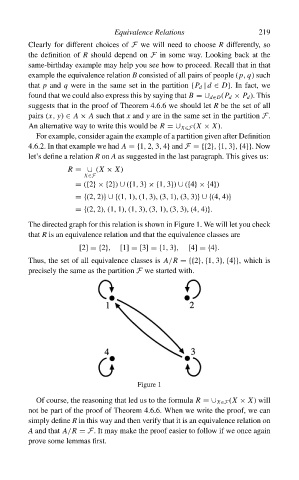
                            The directed graph for this relation is shown in Figure 1. We will let you check
                            that R is an equivalence relation and that the equivalence classes are
                                         [2] ={2},  [1] = [3] ={1, 3},  [4] ={4}.
                            Thus, the set of all equivalence classes is A/R ={{2}, {1, 3}, {4}}, which is
                            precisely the same as the partition F we started with.


                                                        Figure 1
                              Of course, the reasoning that led us to the formula R =∪ X∈F (X × X) will
                            not be part of the proof of Theorem 4.6.6. When we write the proof, we can
                            simply define R in this way and then verify that it is an equivalence relation on
                            A and that A/R = F. It may make the proof easier to follow if we once again
                            prove some lemmas first.

