


Page 307 - HOW TO PROVE IT: A Structured Approach, Second Edition
P. 307
P1: Oyk/
                   0521861241c06  CB996/Velleman  October 20, 2005  1:8  0 521 86124 1  Char Count= 0


                                                    Strong Induction                   293
                            Case 2. n = 1. Then
                                               n        n          1        1
                                            √ 	      √ 	        √ 	      √
                                          1+ 5  −  1− 5       1+ 5  −  1− 5
                                           2         2         2         2
                                                √         =         √
                                                 5                   5
                                                             √
                                                              5
                                                          = √ = 1 = F 1 .
                                                              5
                            Case 3. n ≥ 2. Then applying the inductive hypothesis to n − 2 and n − 1,
                            we get
                                 F n = F n−2 + F n−1
                                         √ 	 n−2     √ 	 n−2     √ 	 n−1     √ 	 n−1
                                       1+ 5       1− 5        1+ 5        1− 5
                                        2      −    2           2     −    2
                                   =          √            +          √
                                                5                      5

                                          √ 	 n−2     √ 	 n−1      √ 	 n−2     √ 	 n−1
                                        1+ 5       1+ 5          1− 5       1− 5
                                         2      +    2       −    2      +    2
                                   =                        √
                                                              5
                                         √ 	 n−2     √        √ 	 n−2     √
                                       1+ 5        1+ 5     1− 5         1− 5
                                        2       1 +  2   −    2      1 +  2
                                   =                    √                     .
                                                          5
                              Now note that
                                        2       √             √        √            √
                                    √
                                1 +  5      1 + 2 5 + 5  6 + 2 5    3 +  5      1 +  5
                                         =             =         =        = 1 +        ,
                                   2            4           4         2            2
                            and similarly
                                                         2         √

                                                    √
                                                 1 −  5         1 −  5
                                                          = 1 +       .
                                                   2              2
                            Substituting into the formula for F n ,weget
                                                  n−2      2         n−2      2
                                               √ 	      √ 	       √ 	      √
                                             1+ 5     1+ 5      1− 5     1− 5
                                               2        2    −   2         2
                                       F n =                √
                                                              5
                                                  n         n
                                               √ 	      √
                                             1+ 5      1− 5
                                               2   −    2
                                         =         √         .
                                                    5
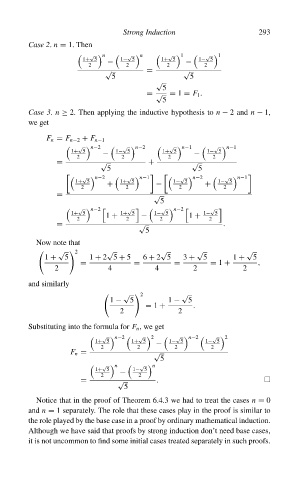
                              Notice that in the proof of Theorem 6.4.3 we had to treat the cases n = 0
                            and n = 1 separately. The role that these cases play in the proof is similar to
                            the role played by the base case in a proof by ordinary mathematical induction.
                            Although we have said that proofs by strong induction don’t need base cases,
                            it is not uncommon to find some initial cases treated separately in such proofs.

