


Page 302 - HOW TO PROVE IT: A Structured Approach, Second Edition
P. 302
P1: Oyk/
                   0521861241c06  CB996/Velleman  October 20, 2005  1:8  0 521 86124 1  Char Count= 0


                                   288                  Mathematical Induction
                                                                                      n

                                          (This is called the binomial theorem, so the numbers  are some-
                                                                                      k
                                          times called binomial coefficients.)
                                                                                           n

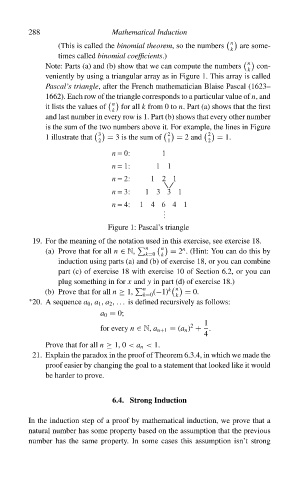
                                       Note: Parts (a) and (b) show that we can compute the numbers  con-
                                                                                           k
                                       veniently by using a triangular array as in Figure 1. This array is called
                                       Pascal’s triangle, after the French mathematician Blaise Pascal (1623–
                                       1662). Each row of the triangle corresponds to a particular value of n, and
                                                        n

                                       it lists the values of  for all k from 0 to n. Part (a) shows that the first
                                                        k
                                       and last number in every row is 1. Part (b) shows that every other number
                                       is the sum of the two numbers above it. For example, the lines in Figure
                                                                                2
                                                    3
                                                                      2

                                       1 illustrate that  = 3 is the sum of  = 2 and  = 1.
                                                    2                 1         2
                                                        n = 0:       1
                                                        n = 1:     11
                                                        n = 2:    1 2  1
                                                        n = 3:  1 3   3 1
                                                        n = 4:  1 4  6 4 1
                                                                     :
                                                                     :
                                                       Figure 1: Pascal’s triangle
                                    19. For the meaning of the notation used in this exercise, see exercise 18.
                                                                    n
                                                                n         n
                                       (a) Prove that for all n ∈ N,   = 2 . (Hint: You can do this by
                                                                k=0  k
                                          induction using parts (a) and (b) of exercise 18, or you can combine
                                          part (c) of exercise 18 with exercise 10 of Section 6.2, or you can
                                          plug something in for x and y in part (d) of exercise 18.)

                                                                n     k n
                                       (b) Prove that for all n ≥ 1,  (−1)  = 0.
                                                                k=0     k
                                    20. A sequence a 0 , a 1 , a 2 , . . . is defined recursively as follows:
                                   ∗
                                                     a 0 = 0;
                                                                               1
                                                                            2
                                                     for every n ∈ N, a n+1 = (a n ) + .
                                                                               4
                                       Prove that for all n ≥ 1, 0 < a n < 1.
                                    21. Explain the paradox in the proof of Theorem 6.3.4, in which we made the
                                       proof easier by changing the goal to a statement that looked like it would
                                       be harder to prove.
                                                        6.4. Strong Induction


                                   In the induction step of a proof by mathematical induction, we prove that a
                                   natural number has some property based on the assumption that the previous
                                   number has the same property. In some cases this assumption isn’t strong

