


Page 310 - HOW TO PROVE IT: A Structured Approach, Second Edition
P. 310
P1: Oyk/
                   0521861241c06  CB996/Velleman  October 20, 2005  1:8  0 521 86124 1  Char Count= 0


                                   296                  Mathematical Induction
                                       P(n) is a statement about a natural number n, and suppose that
                                       ∀n[(∀k < nP(k)) → P(n)]. Let Q(n) be the statement ∀k < nP(k).
                                       (a) Prove ∀nQ(n) ↔∀nP(n) without using induction.
                                       (b) Prove ∀nQ(n)by ordinary induction. Thus, by part (a), ∀nP(n)is
                                          true.
                                                                                            √
                                    2. This exercise gives an alternative way of writing the proof that  2is
                                       irrational. Use strong induction to prove that ∀q ∈ N[q > 0 →¬∃p ∈
                                               √
                                       N(p/q =   2)].
                                                   √
                                    ∗ 3. (a) Prove that  6 is irrational.
                                                   √    √
                                       (b) Prove that  2 +  3 is irrational.
                                    4. The Martian monetary system uses colored beads instead of coins. A blue
                                       bead is worth 3 Martian credits, and a red bead is worth 7 Martian credits.
                                       Thus, three blue beads are worth 9 credits, and a blue and red bead together
                                       are worth 10 credits, but no combination of blue and red beads is worth
                                       11 credits. Prove that for all n ≥ 12, there is some combination of blue
                                       and red beads that is worth n credits.
                                    5. Suppose that x is a real number, x  = 0, and x + 1/x is an integer. Prove
                                                             n
                                                      n
                                       that for all n ≥ 1, x + 1/x is an integer.
                                    ∗              th
                                    6. Let F n be the n Fibonacci number. All variables in this exercise range
                                       over N
                                                            n
                                       (a) Prove that for all n,  i=0  F i = F n+2 − 1.
                                                            n     2
                                       (b) Prove that for all n,  i=0 (F i ) = F n F n+1 .
                                                            n
                                       (c) Prove that for all n,  F 2i+1 = F 2n+2 .
                                                            i=0
                                       (d) Find a formula for    n  F 2i and prove that your formula is correct.
                                                           i=0
                                                   th
                                    7. Let F n be the n Fibonacci number. All variables in this exercise range
                                       over N.
                                       (a) Prove that for all m ≥ 1 and all n, F m+n = F m−1 F n + F m F n+1 .
                                       (b) Prove that for all m ≥ 1 and all n ≥ 1, F m+n = F m+1 F n+1 −
                                          F m−1 F n−1 .
                                                             2        2                2     2
                                       (c) Prove that for all n,(F n ) + (F n+1 ) = F 2n+1 and (F n+2 ) − (F n ) =
                                          F 2n+2 .
                                       (d) Prove that for all m and n,if m | n then F m | F n .
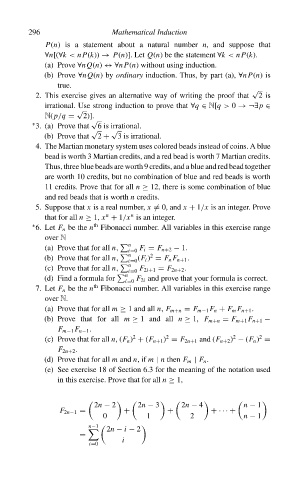
                                       (e) See exercise 18 of Section 6.3 for the meaning of the notation used
                                          in this exercise. Prove that for all n ≥ 1,


                                                   2n − 2      2n − 3     2n − 4          n − 1

                                           F 2n−1 =        +          +          + ··· +
                                                      0          1          2             n − 1
                                                  n−1
                                                       2n − i − 2
                                                =
                                                          i
                                                  i=0

