


Page 315 - HOW TO PROVE IT: A Structured Approach, Second Edition
P. 315
P1: Oyk/
                   0521861241c06  CB996/Velleman  October 20, 2005  1:8  0 521 86124 1  Char Count= 0


                                                     Closures Again                    301
                              Base case: When n = 1wehave
                                                  m
                                          R m+1  = R ◦ R  (by definition of R m+1 )
                                                                         1
                                                  m
                                               = R ◦ R 1  (by definition of R ).
                              Induction step: Let n be an arbitrary positive integer and suppose R m+n  =
                             m
                                  n
                            R ◦ R . Then
                                 R m+(n+1)  = R (m+n)+1
                                         = R m+n  ◦ R     (by definition of R (m+n)+1 )
                                             m
                                                  n
                                         = (R ◦ R ) ◦ R   (by inductive hypothesis)
                                                  n
                                             m
                                         = R ◦ (R ◦ R)    (by associativity of composition)
                                             m
                                         = R ◦ R n+1      (by definition of R  n+1 ).
                              We can now say precisely how to form the transitive closure of R.
                                                                       n
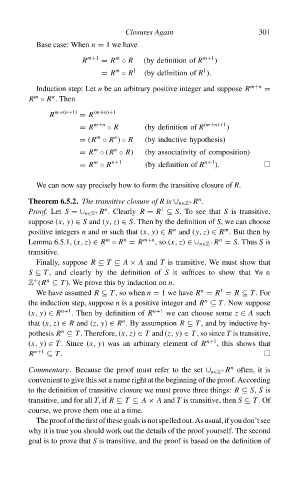
                            Theorem 6.5.2. The transitive closure of R is ∪ n∈Z R .
                                                                     +
                                                              1
                                               n
                            Proof. Let S =∪ n∈Z R . Clearly R = R ⊆ S. To see that S is transitive,
                                             +
                            suppose (x, y) ∈ S and (y, z) ∈ S. Then by the definition of S, we can choose
                                                                 n
                                                                              m
                            positive integers n and m such that (x, y) ∈ R and (y, z) ∈ R . But then by
                                                                             n
                                                m
                                                    n
                            Lemma 6.5.1, (x, z) ∈ R ◦ R = R m+n ,so(x, z) ∈∪ n∈Z R = S. Thus S is
                                                                          +
                            transitive.
                              Finally, suppose R ⊆ T ⊆ A × A and T is transitive. We must show that
                            S ⊆ T , and clearly by the definition of S it suffices to show that ∀n ∈
                                 n
                             +
                            Z (R ⊆ T ). We prove this by induction on n.
                                                                        n
                                                                             1
                              We have assumed R ⊆ T , so when n = 1wehave R = R = R ⊆ T .For
                                                                         n
                            the induction step, suppose n is a positive integer and R ⊆ T . Now suppose
                            (x, y) ∈ R n+1 . Then by definition of R n+1  we can choose some z ∈ A such
                                                    n
                            that (x, z) ∈ R and (z, y) ∈ R . By assumption R ⊆ T , and by inductive hy-
                                    n
                            pothesis R ⊆ T . Therefore, (x, z) ∈ T and (z, y) ∈ T , so since T is transitive,
                            (x, y) ∈ T . Since (x, y) was an arbitrary element of R n+1 , this shows that
                            R n+1  ⊆ T .
                                                                                n
                            Commentary . Because the proof must refer to the set ∪ n∈Z R often, it is
                                                                             +
                            convenient to give this set a name right at the beginning of the proof. According
                            to the definition of transitive closure we must prove three things: R ⊆ S, S is
                            transitive, and for all T,if R ⊆ T ⊆ A × A and T is transitive, then S ⊆ T .Of
                            course, we prove them one at a time.
                              Theproofofthefirstofthesegoalsisnotspelledout.Asusual,ifyoudon’tsee
                            why it is true you should work out the details of the proof yourself. The second
                            goal is to prove that S is transitive, and the proof is based on the definition of

