


Page 317 - HOW TO PROVE IT: A Structured Approach, Second Edition
P. 317
P1: Oyk/
                   0521861241c06  CB996/Velleman  October 20, 2005  1:8  0 521 86124 1  Char Count= 0


                                                     Closures Again                    303
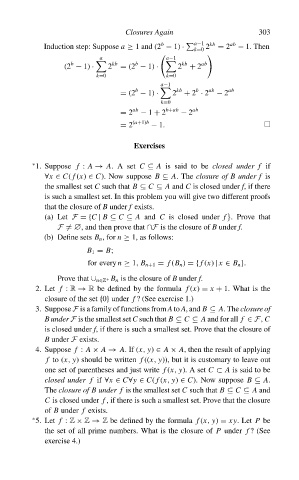
                                                              b       a−1  kb  ab
                                Induction step: Suppose a ≥ 1 and (2 − 1) ·  2  = 2  − 1. Then
                                                                      k=0

                                              a                a−1
                                       b         kb    b           kb   ab
                                     (2 − 1) ·  2  = (2 − 1) ·    2 + 2
                                             k=0               k=0
                                                              a−1
                                                       b          kb   b  ab   ab
                                                   = (2 − 1) ·   2 + 2 · 2  − 2
                                                              k=0
                                                   = 2 ab  − 1 + 2 b+ab  − 2 ab
                                                   = 2 (a+1)b  − 1.

                                                       Exercises

                              1. Suppose f : A → A. A set C ⊆ A is said to be closed under f if
                             ∗
                                ∀x ∈ C( f (x) ∈ C). Now suppose B ⊆ A. The closure of B under f is
                                the smallest set C such that B ⊆ C ⊆ A and C is closed under f, if there
                                is such a smallest set. In this problem you will give two different proofs
                                that the closure of B under f exists.
                                (a) Let F ={C | B ⊆ C ⊆ A and C is closed under f}. Prove that
                                   F  = ∅, and then prove that ∩F is the closure of B under f.
                                (b) Define sets B n , for n ≥ 1, as follows:
                                           B 1 = B;
                                           for every n ≥ 1, B n+1 = f (B n ) ={ f (x) | x ∈ B n }.

                                   Prove that ∪ n∈Z B n is the closure of B under f.
                                                +
                              2. Let f : R → R be defined by the formula f (x) = x + 1. What is the
                                closure of the set {0} under f ? (See exercise 1.)
                              3. Suppose F is a family of functions from A to A, and B ⊆ A. The closure of
                                B under F is the smallest set C such that B ⊆ C ⊆ A and for all f ∈ F, C
                                is closed under f, if there is such a smallest set. Prove that the closure of
                                B under F exists.
                              4. Suppose f : A × A → A.If(x, y) ∈ A × A, then the result of applying
                                 f to (x, y) should be written f ((x, y)), but it is customary to leave out
                                one set of parentheses and just write f (x, y). A set C ⊂ A is said to be
                                closed under f if ∀x ∈ C∀y ∈ C( f (x, y) ∈ C). Now suppose B ⊆ A.
                                The closure of B under f is the smallest set C such that B ⊆ C ⊆ A and
                                C is closed under f , if there is such a smallest set. Prove that the closure
                                of B under f exists.
                              5. Let f : Z × Z → Z be defined by the formula f (x, y) = xy. Let P be
                             ∗
                                the set of all prime numbers. What is the closure of P under f ? (See
                                exercise 4.)

