


Page 321 - HOW TO PROVE IT: A Structured Approach, Second Edition
P. 321
P1: PIG/KNL  P2: IWV/
                   0521861241c07  CB996/Velleman  October 20, 2005  1:12  0 521 86124 1  Char Count= 0


                                                   Equinumerous Sets                   307
                            finite set A to be the unique n such that I n ∼ A. This number is also sometimes
                            called the cardinality of A, and it is denoted |A|. Note that according to this
                            definition, ∅ is finite and |∅|= 0.
                              The definition of equinumerous can also be applied to infinite sets, with
                            results that are sometimes surprising. For example, you might think that Z +
                            could not be equinumerous with Z because Z includes all the positive inte-
                            gers, plus all the negative integers and zero as well. But consider the function
                            f : Z → Z defined as follows:
                                +
                                                       n
                                                     ⎧
                                                     ⎪        if n is even
                                                     ⎪
                                                       2
                                                     ⎨
                                               f (n) =
                                                     ⎪ 1 − n
                                                              if n is odd.
                                                     ⎪
                                                     ⎩
                                                        2
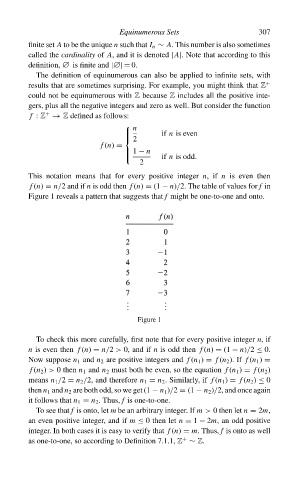
                            This notation means that for every positive integer n,if n is even then
                            f (n) = n/2 and if n is odd then f (n) = (1 − n)/2. The table of values for f in
                            Figure 1 reveals a pattern that suggests that f might be one-to-one and onto.


                                                        Figure 1

                              To check this more carefully, first note that for every positive integer n,if
                            n is even then f (n) = n/2 > 0, and if n is odd then f (n) = (1 − n)/2 ≤ 0.
                            Now suppose n 1 and n 2 are positive integers and f (n 1 ) = f (n 2 ). If f (n 1 ) =
                            f (n 2 ) > 0 then n 1 and n 2 must both be even, so the equation f (n 1 ) = f (n 2 )
                            means n 1 /2 = n 2 /2, and therefore n 1 = n 2 . Similarly, if f (n 1 ) = f (n 2 ) ≤ 0
                            then n 1 and n 2 are both odd, so we get (1 − n 1 )/2 = (1 − n 2 )/2, and once again
                            it follows that n 1 = n 2 . Thus, f is one-to-one.
                              To see that f is onto, let m be an arbitrary integer. If m > 0 then let n = 2m,
                            an even positive integer, and if m ≤ 0 then let n = 1 − 2m, an odd positive
                            integer. In both cases it is easy to verify that f (n) = m. Thus, f is onto as well
                                                                   +
                            as one-to-one, so according to Definition 7.1.1, Z ∼ Z.

