


Page 322 - HOW TO PROVE IT: A Structured Approach, Second Edition
P. 322
P1: PIG/KNL  P2: IWV/
                   0521861241c07  CB996/Velleman  October 20, 2005  1:12  0 521 86124 1  Char Count= 0


                                   308                       Infinite Sets
                                     Note that the function f had to be chosen very carefully. There are many
                                                     +
                                   other functions from Z to Z that are one-to-one but not onto, onto but not
                                   one-to-one, or neither one-to-one nor onto, but this does not contradict our
                                   claim that Z ∼ Z. According to Definition 7.1.1, to show that Z ∼ Z we
                                                                                        +
                                             +
                                   need only show that there is at least one function from Z to Z that is both
                                                                                 +
                                   one-to-one and onto, and of course to prove this it suffices to give an example
                                   of such a function.
                                                                             +
                                                                                  +
                                     Perhaps an even more surprising example is that Z × Z ∼ Z . To show
                                                                                       +
                                                                                               +
                                                                                         +
                                                                                    +
                                   this we must come up with a one-to-one, onto function f : Z × Z → Z .
                                   An element of the domain of this function would be an ordered pair (i, j),
                                   where i and j are positive integers. The result of applying f to this pair should
                                   be written f ((i, j)), but it is customary to leave out one pair of parentheses
                                   and just write f (i, j). Exercise 12 asks you to show that the following formula
                                                       +
                                                            +
                                                                 +
                                   defines a function from Z × Z to Z that is one-to-one and onto:
                                                           (i + j − 2)(i + j − 1)
                                                   f (i, j) =                + i.
                                                                   2
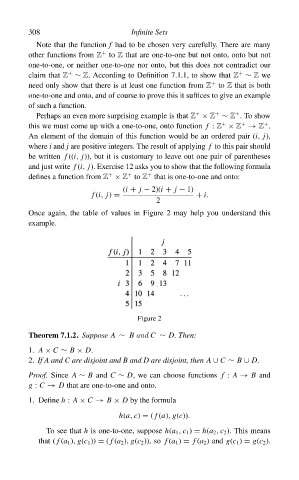
                                   Once again, the table of values in Figure 2 may help you understand this
                                   example.


                                                              Figure 2

                                   Theorem 7.1.2. Suppose A ∼ B and C ∼ D. Then:
                                   1. A × C ∼ B × D.
                                   2. If A and C are disjoint and B and D are disjoint, then A ∪ C ∼ B ∪ D.
                                   Proof. Since A ∼ B and C ∼ D, we can choose functions f : A → B and
                                   g : C → D that are one-to-one and onto.
                                   1. Define h : A × C → B × D by the formula

                                                          h(a, c) = ( f (a), g(c)).
                                       To see that h is one-to-one, suppose h(a 1 , c 1 ) = h(a 2 , c 2 ). This means
                                     that ( f (a 1 ), g(c 1 )) = ( f (a 2 ), g(c 2 )), so f (a 1 ) = f (a 2 ) and g(c 1 ) = g(c 2 ).

