


Page 337 - HOW TO PROVE IT: A Structured Approach, Second Edition
P. 337
P1: PIG/KNL  P2: IWV/
                   0521861241c07  CB996/Velleman  October 20, 2005  1:12  0 521 86124 1  Char Count= 0


                                          The Cantor–Schr¨ oder–Bernstein Theorem      323
                            Scratch work
                            We start by assuming that A   B and B   A, which means that we can choose
                            one-to-one functions f : A → B and g : B → A. To prove that A → B we
                            need to find a one-to-one, onto function h : A → B.
                              At this point, we don’t know much about A and B. The only tools we have to
                            help us match up the elements of A and B are the functions f and g.If f is onto,
                                                                                       −1
                            then of course we can let h = f ; and if g is onto, then we can let h = g .
                            But it may turn out that neither f nor g is onto. How can we come up with the
                            required function h in this case?
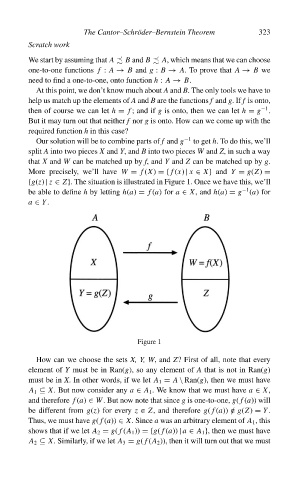
                              Our solution will be to combine parts of f and g −1  to get h. To do this, we’ll
                            split A into two pieces X and Y, and B into two pieces W and Z, in such a way
                            that X and W can be matched up by f, and Y and Z can be matched up by g.
                            More precisely, we’ll have W = f (X) ={ f (x) | x ∈ X} and Y = g(Z) =
                            {g(z) | z ∈ Z}. The situation is illustrated in Figure 1. Once we have this, we’ll
                                                                                   −1
                            be able to define h by letting h(a) = f (a) for a ∈ X, and h(a) = g (a) for
                            a ∈ Y.


                                                        Figure 1

                              How can we choose the sets X, Y, W, and Z? First of all, note that every
                            element of Y must be in Ran(g), so any element of A that is not in Ran(g)
                            must be in X. In other words, if we let A 1 = A \ Ran(g), then we must have
                            A 1 ⊆ X. But now consider any a ∈ A 1 . We know that we must have a ∈ X,
                            and therefore f (a) ∈ W. But now note that since g is one-to-one, g( f (a)) will
                            be different from g(z) for every z ∈ Z, and therefore g( f (a)) /∈ g(Z) = Y.
                            Thus, we must have g( f (a)) ∈ X. Since a was an arbitrary element of A 1 , this
                            shows that if we let A 2 = g( f (A 1 )) ={g( f (a)) | a ∈ A 1 }, then we must have
                            A 2 ⊆ X. Similarly, if we let A 3 = g( f (A 2 )), then it will turn out that we must

