


Page 365 - HOW TO PROVE IT: A Structured Approach, Second Edition
P. 365
P1: PIG/
                   0521861241apx01  CB996/Velleman  October 20, 2005  2:56  0 521 86124 1  Char Count= 0


                                         Appendix 1: Solutions to Selected Exercises   351
                                   1 here just to make sure that c is positive, as required in the definition
                                   of O.) Then for all x > a,

                                   | f (x)|= |sf 1 (x) + tf 2 (x)|≤|s|| f 1 (x)|+|t|| f 2 (x)|
                                         ≤|s|c 1 |g(x)|+|t|c 2 |g(x)|= (|s|c 1 +|t|c 2 )|g(x)|≤ c|g(x)|.
                                   Therefore f ∈ O(g).
                            18. (a) Hint: Let h ={(X, y) ∈ A/R × B |∃x ∈ X( f (x) = y)}.
                               (b) Hint: Use the fact that if xRy then [x] R = [y] R .


                                                      Section 5.2
                             2. (a) f is not a function.
                               (b) f is not a function. g is a function that is onto, but not one-to-one.
                               (c) R is one-to-one and onto.
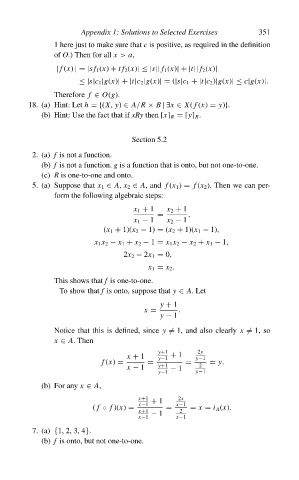
                             5. (a) Suppose that x 1 ∈ A, x 2 ∈ A, and f (x 1 ) = f (x 2 ). Then we can per-
                                   form the following algebraic steps:
                                                       x 1 + 1  x 2 + 1
                                                             =       ,
                                                       x 1 − 1  x 2 − 1
                                               (x 1 + 1)(x 2 − 1) = (x 2 + 1)(x 1 − 1),
                                             x 1 x 2 − x 1 + x 2 − 1 = x 1 x 2 − x 2 + x 1 − 1,
                                                    2x 2 − 2x 1 = 0,
                                                           x 1 = x 2 .
                                   This shows that f is one-to-one.
                                    To show that f is onto, suppose that y ∈ A. Let
                                                              y + 1
                                                          x =     .
                                                              y − 1
                                   Notice that this is defined, since y  = 1, and also clearly x  = 1, so
                                   x ∈ A. Then
                                                             y+1       2y
                                                     x + 1   y−1  + 1  y−1
                                               f (x) =    =         =     = y.
                                                     x − 1   y+1  − 1   2
                                                             y−1       y−1
                               (b) For any x ∈ A,
                                                        x+1  + 1  2x
                                                        x−1       x−1
                                            ( f ◦ f )(x) =     =     = x = i A (x).
                                                        x+1  − 1   2
                                                        x−1       x−1
                             7. (a) {1, 2, 3, 4}.
                               (b) f is onto, but not one-to-one.

