


Page 367 - HOW TO PROVE IT: A Structured Approach, Second Edition
P. 367
P1: PIG/
                   0521861241apx01  CB996/Velleman  October 20, 2005  2:56  0 521 86124 1  Char Count= 0


                                         Appendix 1: Solutions to Selected Exercises   353
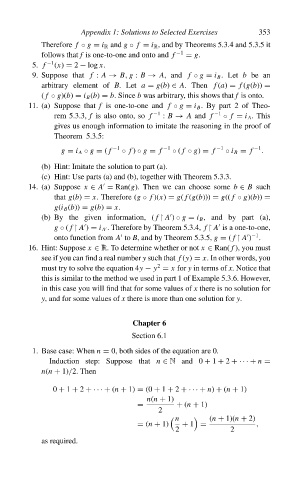
                               Therefore f ◦ g = i R and g ◦ f = i R , and by Theorems 5.3.4 and 5.3.5 it
                               follows that f is one-to-one and onto and f  −1  = g.
                             5. f  −1 (x) = 2 − log x.
                             9. Suppose that f : A → B, g : B → A, and f ◦ g = i B . Let b be an
                               arbitrary element of B. Let a = g(b) ∈ A. Then f (a) = f (g(b)) =
                               ( f ◦ g)(b) = i B (b) = b. Since b was arbitrary, this shows that f is onto.
                            11. (a) Suppose that f is one-to-one and f ◦ g = i B . By part 2 of Theo-
                                   rem 5.3.3, f is also onto, so f  −1  : B → A and f  −1  ◦ f = i A . This
                                   gives us enough information to imitate the reasoning in the proof of
                                   Theorem 5.3.5:

                                    g = i A ◦ g = ( f  −1  ◦ f ) ◦ g = f  −1  ◦ ( f ◦ g) = f  −1  ◦ i B = f  −1 .
                               (b) Hint: Imitate the solution to part (a).
                               (c) Hint: Use parts (a) and (b), together with Theorem 5.3.3.

                            14. (a) Suppose x ∈ A = Ran(g). Then we can choose some b ∈ B such
                                   that g(b) = x. Therefore (g ◦ f )(x) = g( f (g(b))) = g(( f ◦ g)(b)) =
                                   g(i B (b)) = g(b) = x.

                               (b) By the given information, ( f   A ) ◦ g = i B , and by part (a),
                                   g ◦ ( f   A ) = i A . Therefore by Theorem 5.3.4, f   A is a one-to-one,


                                                                                      −1

                                   onto function from A to B, and by Theorem 5.3.5, g = ( f   A ) .
                            16. Hint: Suppose x ∈ R. To determine whether or not x ∈ Ran( f ), you must
                               see if you can find a real number y such that f (y) = x. In other words, you
                                                             2
                               must try to solve the equation 4y − y = x for y in terms of x. Notice that
                               this is similar to the method we used in part 1 of Example 5.3.6. However,
                               in this case you will find that for some values of x there is no solution for
                               y, and for some values of x there is more than one solution for y.
                                                       Chapter 6
                                                      Section 6.1
                             1. Base case: When n = 0, both sides of the equation are 0.
                                 Induction step: Suppose that n ∈ N and 0 + 1 + 2 +· · · + n =
                               n(n + 1)/2. Then

                                  0 + 1 + 2 +· · · + (n + 1) = (0 + 1 + 2 +· · · + n) + (n + 1)
                                                          n(n + 1)
                                                        =         + (n + 1)
                                                             2
                                                                 n        (n + 1)(n + 2)

                                                        = (n + 1)  + 1 =              ,
                                                                  2             2
                               as required.

