


Page 39 - HOW TO PROVE IT: A Structured Approach, Second Edition
P. 39
P1: PIG/
                   0521861241c01  CB996/Velleman  October 19, 2005  23:46  0 521 86124 1  Char Count= 0


                                                      Truth Tables                      25
                                (a) (P ∨ Q) ∧ (¬P ∨¬Q).
                                (b) (P ∨ Q) ∧ (¬P ∧¬Q).
                                (c) (P ∨ Q) ∨ (¬P ∨¬Q).
                                (d) [P ∧ (Q ∨¬R)] ∨ (¬P ∨ R).
                             10. Use truth tables to check these laws:
                                (a) The second DeMorgan’s law. (The first was checked in the text.)
                                (b) The distributive laws.
                            ∗ 11. Use the laws stated in the text to find simpler formulas equivalent to these
                                formulas. (See Examples 1.2.5 and 1.2.7.)
                                (a) ¬(¬P ∧¬Q).
                                (b) (P ∧ Q) ∨ (P ∧¬Q).
                                (c) ¬(P ∧¬Q) ∨ (¬P ∧ Q).
                             12. Use the laws stated in the text to find simpler formulas equivalent to these
                                formulas. (See Examples 1.2.5 and 1.2.7.)
                                (a) ¬(¬P ∨ Q) ∨ (P ∧¬R).
                                (b) ¬(¬P ∧ Q) ∨ (P ∧¬R).
                                (c) (P ∧ R) ∨ [¬R ∧ (P ∨ Q)].
                             13. Use the first DeMorgan’s law and the double negation law to derive the
                                second DeMorgan’s law.
                            ∗
                             14. Note that the associative laws say only that parentheses are unnecessary
                                when combining three statements with ∧ or ∨. In fact, these laws can be
                                used to justify leaving parentheses out when more than three statements
                                are combined. Use associative laws to show that [P ∧ (Q ∧ R)] ∧ S is
                                equivalent to (P ∧ Q) ∧ (R ∧ S).
                             15. How many lines will there be in the truth table for a statement containing
                                n letters?
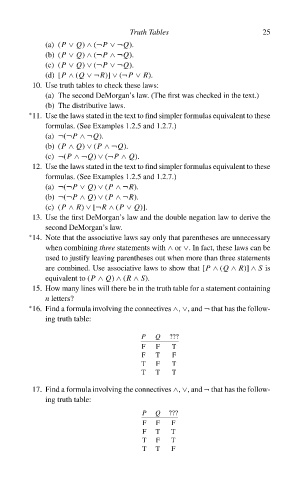
                             16. Find a formula involving the connectives ∧, ∨, and ¬ that has the follow-
                            ∗
                                ing truth table:
                                                         P  Q   ???
                                                         F   F   T
                                                         F  T    F
                                                         T   F   T
                                                         T  T    T

                             17. Find a formula involving the connectives ∧, ∨, and ¬ that has the follow-
                                ing truth table:
                                                         P  Q   ???
                                                         F   F  F
                                                         F  T   T
                                                         T   F  T
                                                         T  T   F

