


Page 34 - HOW TO PROVE IT: A Structured Approach, Second Edition
P. 34
P1: PIG/
                   0521861241c01  CB996/Velleman  October 19, 2005  23:46  0 521 86124 1  Char Count= 0


                                   20                      Sentential Logic
                                   the argument is invalid. Translating the formula L ∨ S back into English, we
                                   see that the first premise could have been stated more simply as “John is either
                                   lazy or stupid (or both).” But from this premise and the second premise (that
                                   John is stupid), it clearly doesn’t follow that he’s not lazy, because he might be
                                   both stupid and lazy.

                                   Example 1.2.4. Which of these formulas are equivalent?

                                                ¬(P ∧ Q),    ¬P ∧¬Q,      ¬P ∨¬Q.
                                   Solution
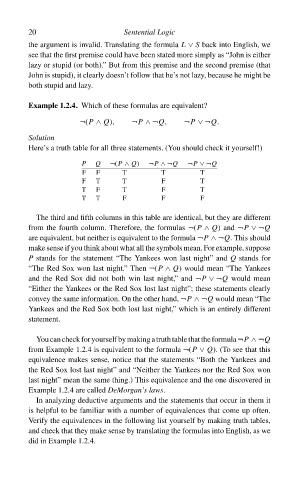
                                   Here’s a truth table for all three statements. (You should check it yourself!)

                                                P   Q  ¬(P ∧ Q)  ¬P ∧¬Q    ¬P ∨¬Q
                                                F   F      T        T         T
                                                F   T      T         F        T
                                                T   F      T         F        T
                                                T   T      F         F        F

                                     The third and fifth columns in this table are identical, but they are different
                                   from the fourth column. Therefore, the formulas ¬(P ∧ Q) and ¬P ∨¬Q
                                   are equivalent, but neither is equivalent to the formula ¬P ∧¬Q. This should
                                   make sense if you think about what all the symbols mean. For example, suppose
                                   P stands for the statement “The Yankees won last night” and Q stands for
                                   “The Red Sox won last night.” Then ¬(P ∧ Q) would mean “The Yankees
                                   and the Red Sox did not both win last night,” and ¬P ∨¬Q would mean
                                   “Either the Yankees or the Red Sox lost last night”; these statements clearly
                                   convey the same information. On the other hand, ¬P ∧¬Q would mean “The
                                   Yankees and the Red Sox both lost last night,” which is an entirely different
                                   statement.

                                     Youcancheckforyourselfbymakingatruthtablethattheformula¬P ∧¬Q
                                   from Example 1.2.4 is equivalent to the formula ¬(P ∨ Q). (To see that this
                                   equivalence makes sense, notice that the statements “Both the Yankees and
                                   the Red Sox lost last night” and “Neither the Yankees nor the Red Sox won
                                   last night” mean the same thing.) This equivalence and the one discovered in
                                   Example 1.2.4 are called DeMorgan’s laws.
                                     In analyzing deductive arguments and the statements that occur in them it
                                   is helpful to be familiar with a number of equivalences that come up often.
                                   Verify the equivalences in the following list yourself by making truth tables,
                                   and check that they make sense by translating the formulas into English, as we
                                   did in Example 1.2.4.

