


Page 36 - HOW TO PROVE IT: A Structured Approach, Second Edition
P. 36
P1: PIG/
                   0521861241c01  CB996/Velleman  October 19, 2005  23:46  0 521 86124 1  Char Count= 0


                                   22                      Sentential Logic
                                   P,if ¬¬P occurs in any formula, you can always replace it with P and the
                                   resulting formula will be equivalent to the original.

                                   Example 1.2.5. Find simpler formulas equivalent to these formulas:
                                   1. ¬(P ∨¬Q).
                                   2. ¬(Q ∧¬P) ∨ P.
                                   Solutions
                                   1. ¬(P ∨¬Q)
                                                is equivalent to ¬P ∧¬¬Q      (DeMorgan’s law),
                                           which is equivalent to ¬P ∧ Q      (double negation law).


                                     You can check that this equivalence is right by making a truth table for
                                     ¬P ∧ Q and seeing that it is the same as the truth table for ¬(P ∨¬Q)
                                     found in Example 1.2.1.
                                   2. ¬(Q ∧¬P) ∨ P
                                                is equivalent to (¬Q ∨¬¬P) ∨ P (DeMorgan’s law),
                                           which is equivalent to (¬Q ∨ P) ∨ P  (double negation law),
                                           which is equivalent to ¬Q ∨ (P ∨ P)  (associative law),
                                           which is equivalent to ¬Q ∨ P      (idempotent law).

                                     Some equivalences are based on the fact that certain formulas are either
                                   always true or always false. For example, you can verify by making a truth
                                   table that the formula Q ∧ (P ∨¬P) is equivalent to just Q. But even before
                                   you make the truth table, you can probably see why they are equivalent. In every
                                   line of the truth table, P ∨¬P will come out true, and therefore Q ∧ (P ∨¬P)
                                   will come out true when Q is also true, and false when Q is false. Formulas that
                                   are always true, such as P ∨¬P, are called tautologies. Similarly, formulas
                                   that are always false are called contradictions. For example, P ∧¬P is a
                                   contradiction.
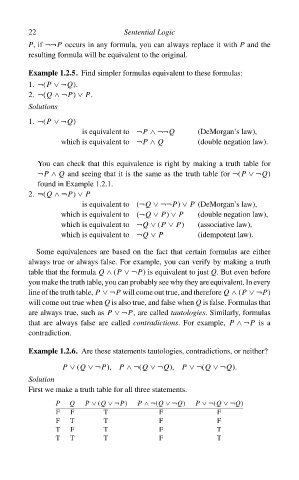
                                   Example 1.2.6. Are these statements tautologies, contradictions, or neither?

                                           P ∨ (Q ∨¬P), P ∧¬(Q ∨¬Q), P ∨¬(Q ∨¬Q).
                                   Solution
                                   First we make a truth table for all three statements.
                                          P  Q   P ∨ (Q ∨¬P)  P ∧¬(Q ∨¬Q)    P ∨¬(Q ∨¬Q)
                                          F  F        T             F              F
                                          F  T        T             F              F
                                          T  F        T             F              T
                                          T  T        T             F              T

