


Page 66 - HOW TO PROVE IT: A Structured Approach, Second Edition
P. 66
P1: PIG/
                   0521861241c01  CB996/Velleman  October 19, 2005  23:46  0 521 86124 1  Char Count= 0


                                   52                      Sentential Logic
                                     We have already seen that a conditional statement P → Q and its converse
                                   Q → P are not equivalent. Often in mathematics we want to say that both
                                   P → Q and Q → P are true, and it is therefore convenient to introduce a
                                   new connective symbol, ↔, to express this. You can think of P ↔ Q as just
                                   an abbreviation for the formula (P → Q) ∧ (Q → P). A statement of the
                                   form P ↔ Q is called a biconditional statement, because it represents two
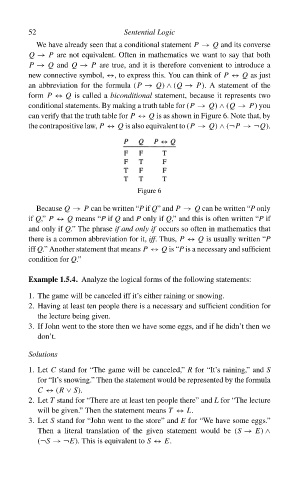
                                   conditional statements. By making a truth table for (P → Q) ∧ (Q → P) you
                                   can verify that the truth table for P ↔ Q is as shown in Figure 6. Note that, by
                                   the contrapositive law, P ↔ Q is also equivalent to (P → Q) ∧ (¬P →¬Q).


                                                              Figure 6

                                     Because Q → P can be written “P if Q” and P → Q can be written “P only
                                   if Q,” P ↔ Q means “P if Q and P only if Q,” and this is often written “P if
                                   and only if Q.” The phrase if and only if occurs so often in mathematics that
                                   there is a common abbreviation for it, iff. Thus, P ↔ Q is usually written “P
                                   iff Q.” Another statement that means P ↔ Q is “P is a necessary and sufficient
                                   condition for Q.”

                                   Example 1.5.4. Analyze the logical forms of the following statements:

                                   1. The game will be canceled iff it’s either raining or snowing.
                                   2. Having at least ten people there is a necessary and sufficient condition for
                                     the lecture being given.
                                   3. If John went to the store then we have some eggs, and if he didn’t then we
                                     don’t.

                                   Solutions

                                   1. Let C stand for “The game will be canceled,” R for “It’s raining,” and S
                                     for “It’s snowing.” Then the statement would be represented by the formula
                                     C ↔ (R ∨ S).
                                   2. Let T stand for “There are at least ten people there” and L for “The lecture
                                     will be given.” Then the statement means T ↔ L.
                                   3. Let S stand for “John went to the store” and E for “We have some eggs.”
                                     Then a literal translation of the given statement would be (S → E) ∧
                                     (¬S →¬E). This is equivalent to S ↔ E.

