


Page 65 - HOW TO PROVE IT: A Structured Approach, Second Edition
P. 65
P1: PIG/
                   0521861241c01  CB996/Velleman  October 19, 2005  23:46  0 521 86124 1  Char Count= 0


                                        The Conditional and Biconditional Connectives   51
                              Some of these may require further explanation. The second expression,
                            “Q,if P,” is just a slight rearrangement of the statement “If P then Q,” so
                            it should make sense that it means P → Q. As an example of a statement of
                            the form “P only if Q,” consider the sentence “You can run for president only if
                            you are a citizen.” In this case, P is “You can run for president” and Q is “You
                            are a citizen.” What the statement means is that if you’re not a citizen, then you
                            can’t run for president, or in other words ¬Q →¬P. But by the contrapositive
                            law, this is equivalent to P → Q.
                              Think of “P is a sufficient condition for Q” as meaning “The truth of P
                            suffices to guarantee the truth of Q,” and it should make sense that this should
                            be represented by P → Q. Finally, “Q is a necessary condition for P” means
                            that in order for P to be true, it is necessary for Q to be true also. This means
                            that if Q isn’t true, then P can’t be true either, or in other words, ¬Q →¬P.
                            Once again, by the contrapositive law we get P → Q.


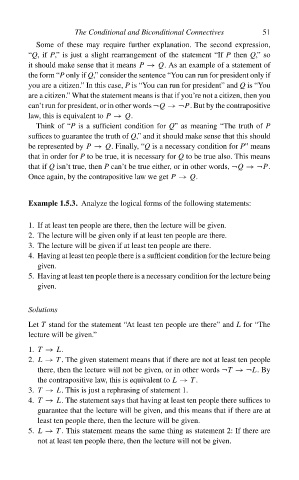
                            Example 1.5.3. Analyze the logical forms of the following statements:

                            1. If at least ten people are there, then the lecture will be given.
                            2. The lecture will be given only if at least ten people are there.
                            3. The lecture will be given if at least ten people are there.
                            4. Having at least ten people there is a sufficient condition for the lecture being
                              given.
                            5. Having at least ten people there is a necessary condition for the lecture being
                              given.


                            Solutions
                            Let T stand for the statement “At least ten people are there” and L for “The
                            lecture will be given.”
                            1. T → L.
                            2. L → T . The given statement means that if there are not at least ten people
                              there, then the lecture will not be given, or in other words ¬T →¬L.By
                              the contrapositive law, this is equivalent to L → T .
                            3. T → L. This is just a rephrasing of statement 1.
                            4. T → L. The statement says that having at least ten people there suffices to
                              guarantee that the lecture will be given, and this means that if there are at
                              least ten people there, then the lecture will be given.
                            5. L → T . This statement means the same thing as statement 2: If there are
                              not at least ten people there, then the lecture will not be given.

