


Page 63 - HOW TO PROVE IT: A Structured Approach, Second Edition
P. 63
P1: PIG/
                   0521861241c01  CB996/Velleman  October 19, 2005  23:46  0 521 86124 1  Char Count= 0


                                        The Conditional and Biconditional Connectives   49
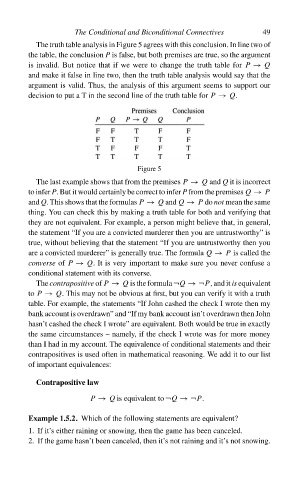
                              The truth table analysis in Figure 5 agrees with this conclusion. In line two of
                            the table, the conclusion P is false, but both premises are true, so the argument
                            is invalid. But notice that if we were to change the truth table for P → Q
                            and make it false in line two, then the truth table analysis would say that the
                            argument is valid. Thus, the analysis of this argument seems to support our
                            decision to putaTinthe second line of the truth table for P → Q.


                                                        Figure 5
                              The last example shows that from the premises P → Q and Q it is incorrect
                            to infer P. But it would certainly be correct to infer P from the premises Q → P
                            and Q. This shows that the formulas P → Q and Q → P do not mean the same
                            thing. You can check this by making a truth table for both and verifying that
                            they are not equivalent. For example, a person might believe that, in general,
                            the statement “If you are a convicted murderer then you are untrustworthy” is
                            true, without believing that the statement “If you are untrustworthy then you
                            are a convicted murderer” is generally true. The formula Q → P is called the
                            converse of P → Q. It is very important to make sure you never confuse a
                            conditional statement with its converse.
                              The contrapositive of P → Q is the formula ¬Q →¬P, and it is equivalent
                            to P → Q. This may not be obvious at first, but you can verify it with a truth
                            table. For example, the statements “If John cashed the check I wrote then my
                            bank account is overdrawn” and “If my bank account isn’t overdrawn then John
                            hasn’t cashed the check I wrote” are equivalent. Both would be true in exactly
                            the same circumstances – namely, if the check I wrote was for more money
                            than I had in my account. The equivalence of conditional statements and their
                            contrapositives is used often in mathematical reasoning. We add it to our list
                            of important equivalences:

                              Contrapositive law
                                            P → Q is equivalent to ¬Q →¬P.

                            Example 1.5.2. Which of the following statements are equivalent?
                            1. If it’s either raining or snowing, then the game has been canceled.
                            2. If the game hasn’t been canceled, then it’s not raining and it’s not snowing.

