


Page 111 - DnD_BasicRules_2018
P. 111
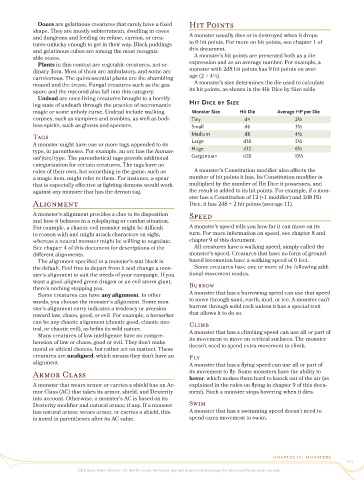
Hit Points
              Oozes are gelatinous creatures that rarely have a fixed
            shape. They are mostly subterranean, dwelling in caves
                                                               A monster usually dies or is destroyed when it drops
            and dungeons and feeding on refuse, carrion, or crea-
                                                               to 0 hit points. For more on hit points, see chapter 1 of
            tures unlucky enough to get in their way. Black puddings
                                                               this document.
            and gelatinous cubes are among the most recogniz-
                                                                 A monster’s hit points are presented both as a die
            able oozes.
                                                               expression and as an average number. For example, a
              Plants in this context are vegetable creatures, not or-
                                                               monster with 2d8 hit points has 9 hit points on aver-
            dinary flora. Most of them are ambulatory, and some are
                                                               age (2 × 4½).
            carnivorous. The quintessential plants are the shambling
                                                                 A monster’s size determines the die used to calculate
            mound and the treant. Fungal creatures such as the gas
                                                               its hit points, as shown in the Hit Dice by Size table.
            spore and the myconid also fall into this category.
              Undead are once-living creatures brought to a horrify-
                                                               Hit Dice by Size
            ing state of undeath through the practice of necromantic
            magic or some unholy curse. Undead include walking   Monster Size  Hit Die      Average HP per Die
            corpses, such as vampires and zombies, as well as bodi-  Tiny        d4              2½
            less spirits, such as ghosts and specters.          Small            d6              3½
            Tags                                                Medium           d8              4½
                                                                Large           d10              5½
            A monster might have one or more tags appended to its
                                                                Huge             d12             6½
            type, in parentheses. For example, an orc has the human-
                                                                Gargantuan      d20              10½
            oid (orc) type. The parenthetical tags provide additional
            categorization for certain creatures. The tags have no
            rules of their own, but something in the game, such as     A monster’s Constitution modifier also affects the
            a magic item, might refer to them. For instance, a spear   number of hit points it has. Its Constitution modifier is
            that is especially effective at fighting demons would work   multiplied by the number of Hit Dice it possesses, and
            against any monster that has the demon tag.        the result is added to its hit points. For example, if a mon-
                                                               ster has a Constitution of 12 (+1 modifier) and 2d8 Hit
            Alignment                                          Dice, it has 2d8 + 2 hit points (average 11).
            A monster’s alignment provides a clue to its disposition   Speed
            and how it behaves in a roleplaying or combat situation.
            For example, a chaotic evil monster might be difficult   A monster’s speed tells you how far it can move on its
            to reason with and might attack characters on sight,   turn. For more information on speed, see chapter 8 and
            whereas a neutral monster might be willing to negotiate.   chapter 9 of this document.
            See chapter 4 of this document for descriptions of the     All creatures have a walking speed, simply called the
            different alignments.                              monster’s speed. Creatures that have no form of ground-
              The alignment specified in a monster’s stat block is   based locomotion have a walking speed of 0 feet.
            the default. Feel free to depart from it and change a mon-    Some creatures have one or more of the following addi-
            ster’s alignment to suit the needs of your campaign. If you   tional movement modes.
            want a good-aligned green dragon or an evil storm giant,   Burrow
            there’s nothing stopping you.
                                                               A monster that has a burrowing speed can use that speed
              Some creatures can have any alignment. In other
                                                               to move through sand, earth, mud, or ice. A monster can’t
            words, you choose the monster’s alignment. Some mon-
                                                               burrow through solid rock unless it has a special trait
            ster’s alignment entry indicates a tendency or aversion
                                                               that allows it to do so.
            toward law, chaos, good, or evil. For example, a berserker
            can be any chaotic alignment (chaotic good, chaotic neu-  Climb
            tral, or chaotic evil), as befits its wild nature.
                                                               A monster that has a climbing speed can use all or part of
              Many creatures of low intelligence have no compre-
                                                               its movement to move on vertical surfaces. The monster
            hension of law or chaos, good or evil. They don’t make
                                                               doesn’t need to spend extra movement to climb.
            moral or ethical choices, but rather act on instinct. These
            creatures are unaligned, which means they don’t have an   Fly
            alignment.
                                                               A monster that has a flying speed can use all or part of
            Armor Class                                        its movement to fly. Some monsters have the ability to
                                                               hover, which makes them hard to knock out of the air (as
            A monster that wears armor or carries a shield has an Ar-  explained in the rules on flying in chapter 9 of this docu-
            mor Class (AC) that takes its armor, shield, and Dexterity   ment). Such a monster stops hovering when it dies.
            into account. Otherwise, a monster’s AC is based on its
            Dexterity modifier and natural armor, if any. If a monster   Swim
            has natural armor, wears armor, or carries a shield, this   A monster that has a swimming speed doesn’t need to
            is noted in parentheses after its AC value.        spend extra movement to swim.


                                                                                           Chapter 12: Monsters
                                                                                                                  111
                                                                                                                  111
                           D&D Basic Rules (Version 1.0). Not for resale. Permission granted to print and photocopy this document for personal use only.

