


Page 113 - DnD_BasicRules_2018
P. 113
Special Traits
            The contact is broken as soon as the two creatures are
            no longer within range of each other or if the telepathic   Special traits (which appear after a monster’s challenge
            monster contacts a different creature within range. A   rating but before any actions or reactions) are character-
            telepathic monster can initiate or terminate a telepathic   istics that are likely to be relevant in a combat encounter
            conversation without using an action, but while the mon-  and that require some explanation.
            ster is incapacitated, it can’t initiate telepathic contact,
            and any current contact is terminated.             Innate Spellcasting
              A creature within the area of an antimagic field or in   A monster with the innate ability to cast spells has the
            any other location where magic doesn’t function can’t   Innate Spellcasting special trait. Unless noted otherwise,
            send or receive telepathic messages.               an innate spell of 1st level or higher is always cast at its
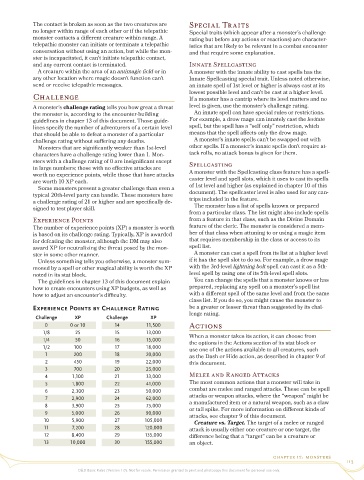
            Challenge                                          lowest possible level and can’t be cast at a higher level.
                                                               If a monster has a cantrip where its level matters and no
            A monster’s challenge rating tells you how great a threat   level is given, use the monster’s challenge rating.
            the monster is, according to the encounter-building     An innate spell can have special rules or restrictions.
            guidelines in chapter 13 of this document. Those guide-  For example, a drow mage can innately cast the levitate
            lines specify the number of adventurers of a certain level   spell, but the spell has a “self only” restriction, which
            that should be able to defeat a monster of a particular   means that the spell affects only the drow mage.
            challenge rating without suffering any deaths.       A monster’s innate spells can’t be swapped out with
              Monsters that are significantly weaker than 1st-level   other spells. If a monster’s innate spells don’t require at-
            characters have a challenge rating lower than 1. Mon-  tack rolls, no attack bonus is given for them.
            sters with a challenge rating of 0 are insignificant except   Spellcasting
            in large numbers; those with no effective attacks are
                                                               A monster with the Spellcasting class feature has a spell-
            worth no experience points, while those that have attacks
                                                               caster level and spell slots, which it uses to cast its spells
            are worth 10 XP each.
                                                               of 1st level and higher (as explained in chapter 10 of this
              Some monsters present a greater challenge than even a
                                                               document). The spellcaster level is also used for any can-
            typical 20th-level party can handle. These monsters have
                                                               trips included in the feature.
            a challenge rating of 21 or higher and are specifically de-
                                                                 The monster has a list of spells known or prepared
            signed to test player skill.
                                                               from a particular class. The list might also include spells
            Experience Points                                  from a feature in that class, such as the Divine Domain
            The number of experience points (XP) a monster is worth   feature of the cleric. The monster is considered a mem-
            is based on its challenge rating. Typically, XP is awarded   ber of that class when attuning to or using a magic item
            for defeating the monster, although the DM may also   that requires membership in the class or access to its
            award XP for neutralizing the threat posed by the mon-  spell list.
            ster in some other manner.                           A monster can cast a spell from its list at a higher level
              Unless something tells you otherwise, a monster sum-  if it has the spell slot to do so. For example, a drow mage
            moned by a spell or other magical ability is worth the XP   with the 3rd-level lightning bolt spell can cast it as a 5th-
            noted in its stat block.                           level spell by using one of its 5th-level spell slots.
              The guidelines in chapter 13 of this document explain     You can change the spells that a monster knows or has
            how to create encounters using XP budgets, as well as   prepared, replacing any spell on a monster’s spell list
            how to adjust an encounter’s difficulty.           with a different spell of the same level and from the same
                                                               class list. If you do so, you might cause the monster to
            Experience Points by Challenge Rating              be a greater or lesser threat than suggested by its chal-
                                                               lenge rating.
             Challenge   XP         Challenge     XP
                0       0 or 10       14         11,500        Actions
               1/8        25          15         13,000
                                                               When a monster takes its action, it can choose from
               1/4        50          16         15,000        the options in the Actions section of its stat block or
               1/2       100          17         18,000        use one of the actions available to all creatures, such
                1        200          18         20,000        as the Dash or Hide action, as described in chapter 9 of
                2        450          19         22,000        this document.
                3        700          20         25,000
                4        1,100        21         33,000        Melee and Ranged Attacks
                5       1,800         22         41,000        The most common actions that a monster will take in
                6       2,300         23         50,000        combat are melee and ranged attacks. These can be spell
                7       2,900         24         62,000        attacks or weapon attacks, where the “weapon” might be
                                                               a manufactured item or a natural weapon, such as a claw
                8       3,900         25         75,000
                                                               or tail spike. For more information on different kinds of
                9       5,000         26         90,000
                                                               attacks, see chapter 9 of this document.
               10       5,900         27        105,000
                                                                 Creature vs. Target. The target of a melee or ranged
               11       7,200         28        120,000
                                                               attack is usually either one creature or one target, the
               12       8,400         29        135,000        difference being that a “target” can be a creature or
               13       10,000        30        155,000        an object.
                                                                                           Chapter 12: Monsters
                                                                                                                  113
                                                                                                                  113
                           D&D Basic Rules (Version 1.0). Not for resale. Permission granted to print and photocopy this document for personal use only.

