


Page 29 - PRE-U STPM CHEMISTRY TERM 1
P. 29
Chemistry Term 1 STPM
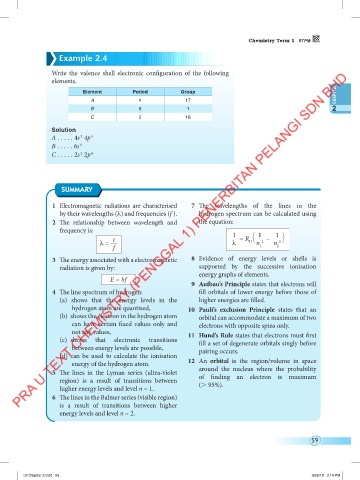
Example 2.4
Write the valence shell electronic configuration of the following
elements.
Element Period Group CHAPTER
A 4 17
2
B 6 1
C 2 18
Solution
2
A . . . . . 4s 4p 5
B . . . . . 6s 1
2
C . . . . . 2s 2p 6
SUMMARY
SUMMARY
1 Electromagnetic radiations are characterised 7 The wavelengths of the lines in the
by their wavelengths (λ) and frequencies (f ). hydrogen spectrum can be calculated using
2 The relationship between wavelength and the equation:
frequency is:
c 1 = R 1 – 1
λ = λ H n 1 2 n 2 2
f
3 The energy associated with a electromagnetic 8 Evidence of energy levels or shells is
radiation is given by: supported by the successive ionisation
energy graphs of elements.
E = hf
9 Aufbau’s Principle states that electrons will
4 The line spectrum of hydrogen: fill orbitals of lower energy before those of
(a) shows that the energy levels in the higher energies are filled.
hydrogen atom are quantised, 10 Pauli’s exclusion Principle states that an
(b) shows the electron in the hydrogen atom orbital can accommodate a maximum of two
can have certain fixed values only and electrons with opposite spins only.
not any values, 11 Hund’s Rule states that electrons must first
(c) shows that electronic transitions fill a set of degenerate orbitals singly before
between energy levels are possible, pairing occurs.
(d) can be used to calculate the ionisation
energy of the hydrogen atom. 12 An orbital is the region/volume in space
5 The lines in the Lyman series (ultra-violet around the nucleus where the probability
region) is a result of transitions between of finding an electron is maximum
higher energy levels and level n = 1. ( 95%).
6 The lines in the Balmer series (visible region)
is a result of transitions between higher
energy levels and level n = 2.
59
02 Chapter 2.indd 59 3/26/18 3:14 PM

