


Page 31 - PRE-U STPM CHEMISTRY TERM 1
P. 31
Chemistry Term 1  STPM
                 11  What is the proton number of an element that has    17  Which of the following elements has 5 unpaired
                    6 unpaired electrons in its ground state?       electrons in its ground state?
                   A  14                C  24                       A  Nitrogen
                   B  22                D  30                       B  Phosphorous
                                                                    C  Manganese
                 12  The lines in the emission spectrum of hydrogen   D  Iron
                    are the results when                                                                        CHAPTER
                   A  electrons are removed from the atom.       18  Which of the following valence configuration is   2
                   B  electrons absorb energy.                      for an atom that can form positive ions of different
                                                                    oxidation state?
                   C  electrons lose energy.                        A  3d  4s           C  3d  4s 2
                                                                                              10
                                                                         10
                                                                            1
                   D  the hydrogen molecules split to form atoms.   B  3s  3p           D  3d  4s 2
                                                                                              1
                                                                            1
                                                                         2
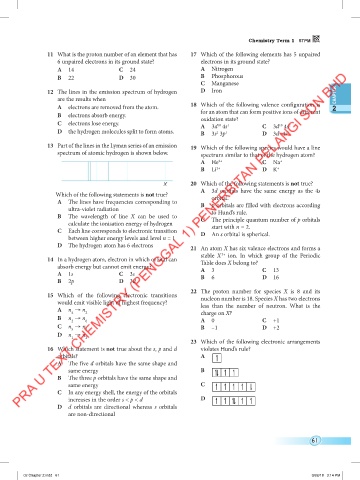
                 13  Part of the lines in the Lyman series of an emission    19  Which of the following species would have a line
                    spectrum of atomic hydrogen is shown below.     spectrum similar to that of the hydrogen atom?
                                                                    A  He 2+            C  Na +
                                                                    B  Li               D  K +
                                                                         2+
                                                       X         20   Which of the following statements is not true?
                   Which of the following statements is not true?   A  3d orbitals have the same energy as the 4s
                                                                       orbital.
                    A  The lines have frequencies corresponding to   B  p orbitals are filled with electrons according
                        ultra-violet radiation                         to Hund’s rule.
                    B  The wavelength of line  X can be used to     C  The principle quantum number of p orbitals
                        calculate the ionisation energy of hydrogen    start with n = 2.
                    C  Each line corresponds to electronic transition   D  An s orbital is spherical.
                        between higher energy levels and level n = 1
                    D  The hydrogen atom has 6 electrons         21  An atom X has six valence electrons and forms a
                                                                          3+
                                                                    stable  X  ion. In which group of the Periodic
                 14  In a hydrogen atom, electron in which orbital can   Table does X belong to?
                    absorb energy but cannot emit energy?           A  3                C  13
                    A  1s               C  3s                       B  6                D  16
                    B  2p               D  3d

                                                                 22  The proton number for species  X is 8 and its
                 15  Which of the following electronic transitions   nucleon number is 18. Species X has two electrons
                    would emit visible light of highest frequency?  less than the number of neutron. What is the
                    A  n  → n
                         4   2                                      charge on X?
                    B  n  → n
                         2   6                                      A  0                C  +1
                    C  n  → n                                       B  –1               D  +2
                         5   1
                    D  n  → n 2
                         1
                                                                 23  Which of the following electronic arrangements
                 16  Which statement is not true about the s, p and d   violates Hund’s rule?
                    orbitals?                                       A
                    A  The five d orbitals have the same shape and
                        same energy                                 B
                    B  The three p orbitals have the same shape and
                        same energy                                 C
                    C  In any energy shell, the energy of the orbitals
                        increases in the order s < p < d            D
                    D  d orbitals are directional whereas  s orbitals
                        are non-directional


                                                                                                        61


         02 Chapter 2.indd   61                                                                         3/26/18   3:14 PM

