


Page 35 - Focus TG4 KSSM (Physics) Terbitan Penerbitan Pelangi Sdn Bhd
P. 35
Physics  Form 4  Chapter 2 Force and Motion I

                 Results:
                                                         Table 2.8
                   1.   Mass of trolley, m / unit     1                  2                   3
                      Initial velocity, u / cm s –1
                      Final velocity, v / cm s –1
                      Acceleration, a / cm s –2

                                                         1
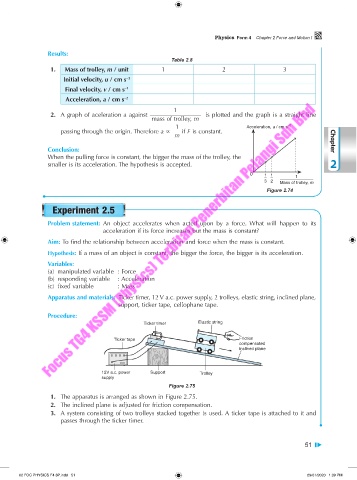
                   2.  A graph of aceleration a against             is plotted and the graph is a straight line
                                                  mass of trolley, m
                                                          1                      Acceleration, a / cm s –2
                     passing through the origin. Therefore a ∝    if F is constant.
                                                          m                                                  Chapter

                 Conclusion:
                 When the pulling force is constant, the bigger the mass of the trolley, the
                 smaller is its acceleration. The hypothesis is accepted.                                   2
                                                                                  0    1 1
                                                                                                 1
                                                                                       – –  –
                                                                                       3 2
                                                                                            Mass of trolley, m
                                                                                        Figure 2.74
                  Experiment 2.5
                  Eksperimen 2.1
                  Eksperimen 2.1
                 Problem statement:  An object accelerates when acted upon by a force.  What will happen to its
                                   acceleration if its force increases but the mass is constant?
                 Aim: To find the relationship between acceleration and force when the mass is constant.

                 Hypothesis: If a mass of an object is constant, the bigger the force, the bigger is its acceleration.
                 Variables:
                 (a)  manipulated variable  : Force
                 (b)  responding variable  : Acceleration
                 (c)  fixed variable   : Mass

                 Apparatus and materials:  Ticker timer, 12 V a.c. power supply, 2 trolleys, elastic string, inclined plane,
                                        support, ticker tape, cellophane tape.
                 Procedure:
                                                Ticker timer      Elastic string

                                      Ticker tape                              Friction
                                                                               compensated
                                                                               inclined plane


                                  12V a.c. power  Support         Trolley
                                  supply
                                                        Figure 2.75
                   1.  The apparatus is arranged as shown in Figure 2.75.
                   2.  The inclined plane is adjusted for friction compensation.
                   3.  A system consisting of two trolleys stacked together is used. A ticker tape is attached to it and
                     passes through the ticker timer.


                                                                                                    51


       02 FOC PHYSICS F4 3P.indd   51                                                                29/01/2020   1:39 PM

