


Page 34 - Focus TG4 KSSM (Physics) Terbitan Penerbitan Pelangi Sdn Bhd
P. 34
Physics  Form 4  Chapter 2 Force and Motion I


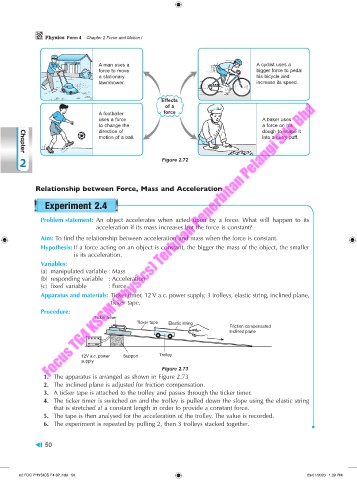
                                 A man uses a                                       A cyclist uses a
                                 force to move                                      bigger force to pedal
                                 a stationary                                       his bicycle and
                                 lawnmower.                                         increase its speed.


                                                      Effects
                                                       of a
                                 A footballer         force
                                 uses a force                                         A baker uses
                                 to change the                                        a force on his
                                 direction of                                         dough to shape it
                                 motion of a ball.                                    into a curry puff.


        Chapter
       2                                              Figure 2.72


             Relationship between Force, Mass and Acceleration
               Eksperimen 2.1
                Experiment 2.4
               Eksperimen 2.1
              Problem statement:  An object accelerates when acted upon by a force.  What will happen to its
                                acceleration if its mass increases but the force is constant?

              Aim: To find the relationship between acceleration and mass when the force is constant.
              Hypothesis: If a force acting on an object is constant, the bigger the mass of the object, the smaller
                         is its acceleration.
              Variables:
              (a)  manipulated variable : Mass
              (b)  responding variable  : Acceleration
              (c)  fixed variable   : Force
              Apparatus and materials: Ticker timer, 12 V a.c. power supply, 3 trolleys, elastic string, inclined plane,
                                     ticker tape.
              Procedure:
                                Ticker timer
                                              Ticker tape  Elastic string
                                                                            Friction compensated
                                                                            inclined plane


                           12V a.c. power  Support   Trolley
                           supply
                                                      Figure 2.73
                1.  The apparatus is arranged as shown in Figure 2.73
                2.  The inclined plane is adjusted for friction compensation.
                3.  A ticker tape is attached to the trolley and passes through the ticker timer.
                4.  The ticker timer is switched on and the trolley is pulled down the slope using the elastic string
                  that is stretched at a constant length in order to provide a constant force.
                5.  The tape is then analysed for the acceleration of the trolley. The value is recorded.
                6.  The experiment is repeated by pulling 2, then 3 trolleys stacked together.


                50


       02 FOC PHYSICS F4 3P.indd   50                                                                29/01/2020   1:39 PM

