


Page 55 - Focus TG4 KSSM (Physics) Terbitan Penerbitan Pelangi Sdn Bhd
P. 55
Physics Form 4 Answers
(ii) Acceleration of the car, a Checkpoint 3.3 GM
F Q1 Man-made satellites are artificial (ii) g = R 2
= —
m
GM
0.2 [1] satellite build and made by man. It is g h (R + h) 2
——
=
2.0 launched by a rocket into space and R 2
= 0.1 m s –2 [1] is placed in a specific orbit round the g = R + h g h
5 earth for specific purposes.
The ISS is the largest man-made (iii) g h = R + h 2 g
satellite orbiting the Earth. R
Chapter Natural satellite are any object in = 6 400 2
3 Gravitation space orbiting the larger planets. 6 400 + 12 800
The moon is a natural satellite × 10 N kg –1
orbiting the Earth. = 1.1 N kg –1
Checkpoint 3.1 W = mg = 81 × 1.1 = 89.1 N
GM
Q1 F = G Mm Q2 v = r + h 3. (a) A geostationary satellite is a
R 2 satellite in the geostationary
–11
= 6.67 × 10 × 7 × 7 = 6.67 × 10 × 5.97 × 10 24 orbit round the Earth on an
–11
6.37 × 10 + 500 000
2
2
6
= 8.17 × 10 N equatorial plane. It moves in
–10
= 7 613 m s = 7.61 km s –1 orbit round the Earth, from east
–1
1
Q2 (a) F ∝ to west, and has a period of
r 2 Q3 v = 2GM 24-hour or one-day.
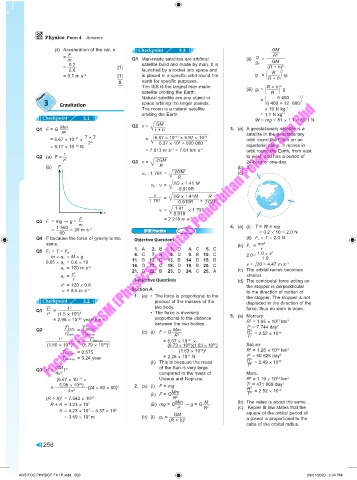
(b) F R (b) 3
v Y : 1 791 = 2GM (c)
R
v X : v = 2G × 1.41 M
0.919R
v 2G × 1.41M R
=
1 791 0.919R × 2GM
v = 1.41 × 1 791
r 0.919
F
Q3 F = mg → g = m = 2 218 m s –1
= 1 560 = 26 m s –2 SPM Practice 3 4. (a) (i) T = W = mg
60 = 0.2 × 10 = 2.0 N
Q4 F because the force of gravity is the Objective Questions (ii) F c = T = 2.0 N
same. (b) F c = mv 2
1. A 2. B 3. D 4. C 5. C r
Q5 F c = T = F w 6. C 7. B 8. D 9. B 10. C 1.0 × v 2
m × a c = M × g 2.0 = 1.0
0.05 × a c = 0.6 × 10 11. B 12. D 13. B 14. D 15. B v = 20 = 4.47 m s –1
a c = 120 m s –2 16. D 17. C 18. D 19. B 20. C (c) The orbital radius becomes
21. D 22. B 23. D 24. C 25. A
a c = v 2 smaller.
r Subjective Questions (d) The centripetal force acting on
v = 120 × 0.6 the stopper is perpendicular
2
v = 8.5 m s –1 Section A to the direction of motion of
1. (a) • The force is proportional to the the stopper. The stopper is not
Checkpoint 3.2 product of the masses of the displaced in the direction of the
two body.
Q1 T 2 = 1 2 • The force is inversely force, thus no work is done.
r 3 (1.5 × 10 ) 5. (a) Mercury:
8 3
= 2.96 × 10 year km –3 proportional to the distance R = 1.85 × 10 km 3
–25
2
23
3
between the two bodies.
2
2 2 T = 7 744 day 2
Q2 T Earth = T Mercury (b) (i) F = G Mm R 3
3
3
19
r Earth r Mercury R 2 T 2 = 2.52 × 10
2
1 2 = T Mercury = 6.67 × 10 ×
–11
10 3
(1.50 × 10 ) (5.79 × 10 ) (8.73 × 10 )(1.03 × 10 ) Saturn:
11 3
26
25
12 2 R = 1.26 × 10 km 3
3
24
2
T Mercury = 0.575 (1.63 × 10 ) 2 2
17
T Mercury = 0.24 year = 2.26 × 10 N T = 50 625 day
R
3
(ii) This is because the mass T 2 = 2.49 × 10
19
Q3 r = GM T 2 of the Sun is very large
3
4p 2 compared to the mass of Mars:
23
3
(6.67 × 10 × Uranus and Neptune. R = 1.19 × 10 km 3
–11
2
24
5.98 × 10 ) T = 471 969 day 2
= (24 × 60 × 60) 2 2. (a) (i) F = mg R 3
4p 2 Mm 2 = 2.52 × 10
19
(ii) F = G T
(R + h) = 7.542 × 10 22 R 2 (b) The value is about the same.
3
R + h = 4.23 × 10 7 (iii) mg = G Mm → g = G M 2 (c) Kepler III law states that the
R
r
2
7
h = 4.23 × 10 – 6.37 × 10 6 square of the orbital period of
7
= 3.59 × 10 m (b) (i) g h = GM a planet is proportional to the
(R + h) 2
cube of the orbital radius.
256
ANS FOC PHYSICF F4 1P.indd 256 29/01/2020 2:04 PM

