


Page 50 - Focus TG4 KSSM (Physics) Terbitan Penerbitan Pelangi Sdn Bhd
P. 50
Physics Form 4 Chapter 2 Force and Motion I
Section C
5. When designing a remote control car, a few factors are taken into consideration. These include reaction time
and resistive force.
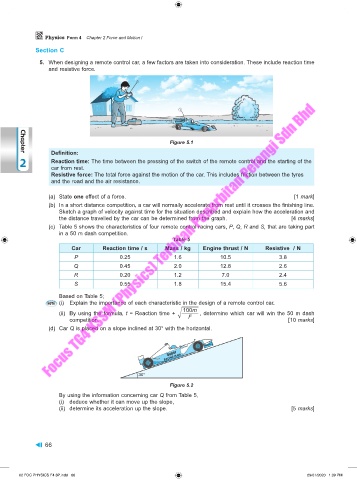
Figure 5.1
Definition:
Chapter
2 Reaction time: The time between the pressing of the switch of the remote control and the starting of the
car from rest.
Resistive force: The total force against the motion of the car. This includes friction between the tyres
and the road and the air resistance.
(a) State one effect of a force. [1 mark]
(b) In a short distance competition, a car will normally accelerate from rest until it crosses the finishing line.
Sketch a graph of velocity against time for the situation described and explain how the acceleration and
the distance travelled by the car can be determined from the graph. [4 marks]
(c) Table 5 shows the characteristics of four remote control racing cars, P, Q, R and S, that are taking part
in a 50 m dash competition.
Table 5
Car Reaction time / s Mass / kg Engine thrust / N Resistive / N
P 0.25 1.6 10.5 3.8
Q 0.45 2.0 12.8 2.6
R 0.20 1.2 7.0 2.4
S 0.55 1.8 15.4 5.6
Based on Table 5;
HOTS (i) Explain the importance of each characteristic in the design of a remote control car.
100m
(ii) By using the formula, t = Reaction time + , determine which car will win the 50 m dash
competition. F [10 marks]
(d) Car Q is placed on a slope inclined at 30° with the horizontal.
Super
30°
Figure 5.2
By using the information concerning car Q from Table 5,
(i) deduce whether it can move up the slope,
(ii) determine its acceleration up the slope. [5 marks]
66
02 FOC PHYSICS F4 3P.indd 66 29/01/2020 1:39 PM

