


Page 12 - Ranger SPM 2022 - Science
P. 12
Science SPM  Chapter 1 Safety Measures in the Laboratory
                3.  Fires  are divided  into  a few types based on the material that has caught fire.
                4.  Table 1.2 shows the types of fires and the suitable fire extinguishers to be used.

                         Table 1.2 Types of fires and suitable types of fire extinguishers to be used
             Penerbitan Pelangi Sdn Bhd. All Rights Reserved.
                  Type of fire               Explanation                  Fire extinguisher

                    Class A     Fires involving flammable solids (except metal)  •  Water
                                such as wood, paper, cloth and any flammable  •  Foam
                                materials                             •  Dry powder

                                Fires involving liquids such as petrol, kerosene,  •  Foam
                    Class B     diesel, paint, varnish and others     •  Dry powder
                                                                      •  Carbon dioxide

                                Fires involving gases such as LPG, LNG, oxygen  •  Dry powder
                    Class C
         Form 4
                                and others                            •  Carbon dioxide
                                Fires involving metals such as magnesium,  •  Dry powder
                    Class D
                                aluminium, sodium, potassium and others
                                Fires involving electrical appliances  •  Dry powder
                    Class E
                                                                      •  Carbon dioxide
                                Fires involving fats and cooking oils  •  Dry powder
                    Class F
                                                                      •  Carbon dioxide

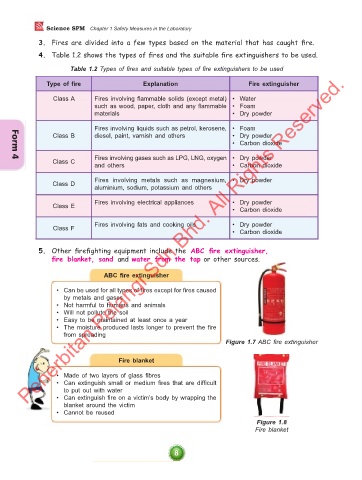
                5.  Other firefighting equipment include  the  ABC  fire  extinguisher,
                    fire  blanket,  sand  and water  from  the  tap or other sources.

                                  ABC fire extinguisher

                     •  Can be used for all types of fires except for fires caused
                       by metals and gases
                     •  Not harmful to humans and animals
                     •  Will not pollute the soil
                     •  Easy to be maintained at least once a year
                     •  The moisture produced lasts longer to prevent the fire
                       from spreading
                                                                    Figure 1.7 ABC fire extinguisher

                                      Fire blanket
                     •  Made of two layers of glass fibres
                     •  Can  extinguish  small  or  medium  fires  that  are  difficult
                       to put out with water
                     •  Can extinguish fire on a victim’s body by wrapping the
                       blanket around the victim
                     •  Cannot be reused
                                                                            Figure 1.8
                                                                            Fire blanket


                                                      8


         F4 Chapter 1.indd   8                                                                3/21/22   3:02 PM

