


Page 33 - Q & A STPM 2022 Biology
P. 33
Biology STPM  Chapter 7 Gaseous Exchange

                    (i)  Explain why the dissociation curves have a sigmoid or ‘S’ shape.
                                                                       (1 mark)
                    (ii)  Which of the following curves is due to the presence of a high level of
                       carbon dioxide.                                (2 marks)
                    (iii)  Describe the physiological advantage resulting from the altered
          Penerbitan Pelangi Sdn Bhd. All Rights Reserved.
                       dissociation curve in the presence of a high level of carbon dioxide.
                                                                      (2 marks)
                    (iv)  Give suggestions on how the effect of carbon monoxide on the
                       oxygen dissociation curve shown contributes to the toxic effect of the
                       gas.                                           (2 marks)


              Answer:
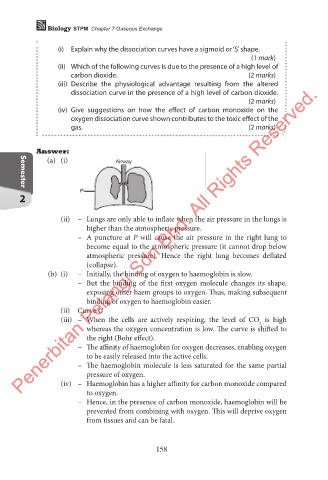
                 (a)  (i)          Airway


                          P
          Semester
          2

                     (ii)  –  Lungs are only able to inflate when the air pressure in the lungs is
                           higher than the atmospheric pressure.
                         –  A puncture at P will cause the air pressure in the right lung to
                           become equal to the atmospheric pressure (it cannot drop below
                           atmospheric pressure). Hence  the right lung  becomes deflated
                           (collapse).
                 (b)  (i)   –  Initially, the binding of oxygen to haemoglobin is slow.
                         –  But  the  binding  of  the  first  oxygen  molecule  changes  its  shape,
                           exposing other haem groups to oxygen. Thus, making subsequent
                           binding of oxygen to haemoglobin easier.
                     (ii)  Curve C
                     (iii)  –  When  the  cells  are  actively  respiring,  the  level  of  CO   is  high
                                                                         2
                           whereas the oxygen concentration is low. The curve is shifted to
                           the right (Bohr effect).
                         –  The affinity of haemoglobin for oxygen decreases, enabling oxygen
                           to be easily released into the active cells.
                         –  The haemoglobin molecule is less saturated for the same partial
                           pressure of oxygen.
                     (iv)  –  Haemoglobin has a higher affinity for carbon monoxide compared
                           to oxygen.
                         –  Hence, in the presence of carbon monoxide, haemoglobin will be
                           prevented from combining with oxygen. This will deprive oxygen
                           from tissues and can be fatal.


                                              158


         Chapter 7.indd   158                                                  11/2/21   9:27 AM

