


Page 37 - Q & A STPM 2022 Biology
P. 37
Biology STPM  Chapter 7 Gaseous Exchange
                     IV : The hydrogen carbonate ions (HCO ) in the red blood cells diffuse
                                                       -
                                                      3
                        out. This causes the red blood cell to become positively charged.
                     V  : Chloride ions diffuse into the red blood cells to neutralise the positive
                        charge in the cells. This process is called the chloride shift.
          Penerbitan Pelangi Sdn Bhd. All Rights Reserved.
                 Section  C    Essay Questions

              Question 1

                 (a)  Explain the structure of haemoglobin and how it is adapted to carry
                    oxygen.                                           (8 marks)
                 (b)  Describe how carbon dioxide is transported by the blood.   (7 marks)


              Answer:
                 (a)  –  Haemoglobin is a conjugated protein
                     –  with a quaternary structure.
          Semester
          2          –  It consists of four polypeptide chains, two alpha and two beta chains
                       coiled to form a spherical structure.
                     –  Each polypeptide chain contains a prosthetic group, haem.
                     –  Within each haem group there is a ferrous iron atom
                     –  Each haem group is able to combine with an oxygen molecule. Hence,
                       there are 4 haem groups in a haemoglobin molecule; therefore each
                       haemoglobin molecule can combine with 4 oxygen molecules.
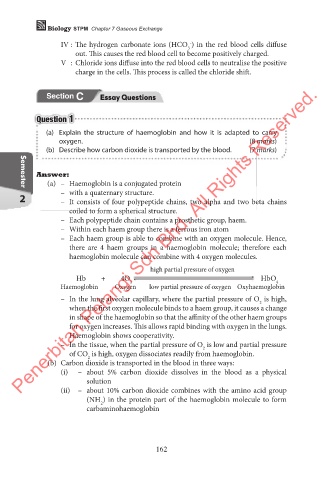
                                            high partial pressure of oxygen
                              Hb    +    4O                                HbO 4
                                       2
                     Haemoglobin   Oxygen   low partial pressure of oxygen  Oxyhaemoglobin
                     –  In the lung alveolar capillary, where the partial pressure of O  is high,
                                                                         2
                       when the first oxygen molecule binds to a haem group, it causes a change
                       in shape of the haemoglobin so that the affinity of the other haem groups
                       for oxygen increases. This allows rapid binding with oxygen in the lungs.
                       Haemoglobin shows cooperativity.
                     –  In the tissue, when the partial pressure of O  is low and partial pressure
                                                          2
                       of CO  is high, oxygen dissociates readily from haemoglobin.
                            2
                 (b)  Carbon dioxide is transported in the blood in three ways:
                     (i)   –  about 5% carbon dioxide dissolves in the blood as a physical
                           solution
                     (ii)  –  about 10% carbon dioxide combines with the amino acid group
                           (NH ) in the protein part of the haemoglobin molecule to form
                               2
                           carbaminohaemoglobin


                                              162


         Chapter 7.indd   162                                                  11/2/21   9:27 AM

