


Page 31 - Focus SPM KSSM F4 2020 - Chemistry
P. 31
Chemistry Form 4  Chapter 3 The Mole Concept, Chemical Formula and Equation
            (a)  What is the meaning of relative atomic mass?                               [1 mark]
            (b)  Give one reason why carbon-12 is used as the standard atom to compare the mass of an atom?
                                                                                            [1 mark]
            (c)  Based on Figure 3.24, state the relative atomic mass of element Y.         [1 mark]
            (d)  In an investigation, Y reacts with bromine gas to form the compound YBr .
                                                                          4
               (i)  Write the chemical equation for the reaction.                           [1 mark]
               (ii)  Interpret the chemical equation in 2(d)(i) quantitatively.             [1 mark]
               (iii)  Using the relative atomic mass of element Y from your answer in 2(c), calculate the number of moles
                   of bromine gas required to react completely with 3.6 g of Y.            [2 marks]
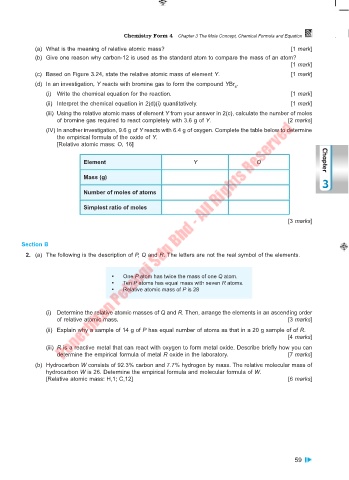
               (IV) In another investigation, 9.6 g of Y reacts with 6.4 g of oxygen. Complete the table below to determine
                   the empirical formula of the oxide of Y.
                   [Relative atomic mass: O, 16]


                           Element                           Y                   O                    Chapter

                           Mass (g)
                                                                                                      3
                           Number of moles of atoms

                           Simplest ratio of moles
                                                                                           [3 marks]


        Section B
          2.  (a)  The following is the description of P, Q and R. The letters are not the real symbol of the elements.


                                    •   One P atom has twice the mass of one Q atom.
                                    •   Ten P atoms has equal mass with seven R atoms.
                                    •   Relative atomic mass of P is 28


               (i)  Determine the relative atomic masses of Q and R. Then, arrange the elements in an ascending order
                   of relative atomic mass.                                                [3 marks]
               (ii)  Explain why a sample of 14 g of P has equal number of atoms as that in a 20 g sample of of R.
                                                                                           [4 marks]
               (iii)  R is a reactive metal that can react with oxygen to form metal oxide. Describe briefly how you can
                   determine the empirical formula of metal R oxide in the laboratory.     [7 marks]
            (b)  Hydrocarbon W consists of 92.3% carbon and 7.7% hydrogen by mass. The relative molecular mass of
               hydrocarbon W is 26. Determine the empirical formula and molecular formula of W.
               [Relative atomic mass: H,1; C,12]                                           [6 marks]


                                                                                             59


 03 SPM CHEMISTRY F4.indd   59                                                               27/02/2020   11:23 AM

