


Page 28 - Focus SPM KSSM F4 2020 - Chemistry
P. 28
Chemistry Form 4  Chapter 3 The Mole Concept, Chemical Formula and Equation

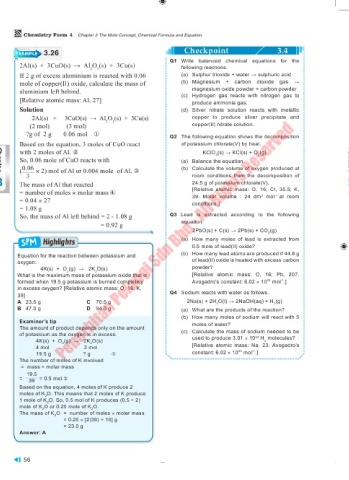
      EXAMPLE 3.26                                         Checkpoint                   3.4
                                                      Q1  Write  balanced  chemical  equations  for  the
       2Al(s)  +  3CuO(s)  →  Al O (s)  +  3Cu(s)         following reactions.
                             2
                               3
       If 2 g of excess aluminium is reacted with 0.06    (a)   Sulphur trioxide + water → sulphuric acid
       mole of copper(II) oxide, calculate the mass of    (b)  Magnesium  +  carbon  dioxide  gas  →
                                                             magnesium oxide powder + carbon powder
       aluminium left behind.                             (c)  Hydrogen  gas  reacts  with  nitrogen  gas  to
       [Relative atomic mass: Al, 27]                        produce ammonia gas.
       Solution                                           (d)  Silver  nitrate  solution  reacts  with  metallic
            2Al(s)   +     3CuO(s)  →  Al O (s)  +  3Cu(s)   copper  to  produce  silver  precipitate  and
                                    3
                                  2
             (2 mol)          (3 mol)                        copper(II) nitrate solution.
           ?g of  2 g       0.06 mol    ①             Q2   The following equation shows the decomposition
       Based on the equation, 3 moles of CuO react        of potassium chlorate(V) by heat.
       with 2 moles of Al. ②                                    KClO (s) → KCl(s) + O (g)
                                                                    3
                                                                                  2
       So, 0.06 mole of CuO reacts with                   (a)   Balance the equation.
       ( 0.06  × 2) mol of Al or 0.004 mole  of Al. ③     (b)   Calculate the volume of oxygen produced at
         3
                                                             room  conditions  from  the  decomposition  of
  Chapter
 3     The mass of Al that reacted                           24.5 g of potassium chlorate(V).
       = number of moles × molar mass ④                      [Relative  atomic  mass:  O,  16;  Cl,  35.5;  K,
                                                             39.  Molar  volume  :  24  dm   mol at  room
                                                                                       -1
                                                                                   3
       = 0.04 × 27                                           conditions.]
       = 1.08 g
       So, the mass of Al left behind = 2 - 1.08 g    Q3  Lead  is  extracted  according  to  the  following
                                 = 0.92 g                 equation.
                                                             2PbO(s) + C(s) → 2Pb(s) + CO (g)
                                                                                     2
        SPM   Highlights                                  (a)   How  many  moles  of  lead  is  extracted  from
                                                             0.5 mole of lead(II) oxide?
       Equation for the reaction between potassium and    (b)   How many lead atoms are produced if 44.6 g
       oxygen:                                               of lead(II) oxide is heated with excess carbon
              4K(s)  +  O (g)  →   2K O(s)                   powder?
                               2
                      2
       What is the maximum mass of potassium oxide that is      [Relative  atomic  mass:  O,  16;  Pb,  207.
       formed when 19.5 g potassium is burned completely     Avogadro’s constant: 6.02 × 10  mol .]
                                                                                         -1
                                                                                    23
       in excess oxygen? [Relative atomic mass: O, 16; K,
       39]                                            Q4   Sodium reacts with water as follows.
       A  23.5 g            C  70.5 g                      2Na(s) + 2H O(l) → 2NaOH(aq) + H (g)
                                                                     2
                                                                                       2
       B  47.0 g            D  94.0 g                     (a)   What are the products of the reaction?
                                                          (b)   How many moles of sodium will react with 5
       Examiner’s tip                                        moles of water?
       The amount of product depends only on the amount   (c)   Calculate the mass of sodium needed to be
       of potassium as the oxygen is in excess.                                  23
            4K(s)  +  O (g)  →   2K O(s)                     used to produce 3.01 × 10  H  molecules?
                                                                                    2
                     2
                             2
            4 mol                       2 mol                [Relative  atomic  mass:  Na,  23. Avogadro’s
                                                                                -1
                                                                            23
            19.5 g                     ? g   ①               constant: 6.02 × 10  mol .]
       The number of moles of K involved
        =  mass ÷ molar mass
         19.5
       =    39   = 0.5 mol ②
       Based on the equation, 4 moles of K produce 2
       moles of K O. This means that 2 moles of K produce
               2
       1 mole of K O. So, 0.5 mol of K produces (0.5 ÷ 2)
                2
       mole of K O or 0.25 mole of K O.
                              2
              2
       The mass of K O  =  number of moles × molar mass
                  2
                     = 0.25 × [2(39) + 16] g
                     = 23.5 g
       Answer: A
        56
 03 SPM CHEMISTRY F4.indd   56                                                               27/02/2020   11:23 AM

