


Page 13 - Pra U STPM 2022 Penggal 2 - Mathematics
P. 13
Mathematics Semester 2  STPM  Chapter 1 Limits and Continuity
                 10.  The function f is defined as follows:
                                           x,          0 < x < 2,
                                    f(x) =  C,         2 , x < 4,                                             1
                                           x  – 4x + 2,  4 , x < 5.
                                            2
                     (a)  Determine the value of C which makes f continuous on the interval 0 < x < 5.
                Penerbitan Pelangi Sdn Bhd. All Rights Reserved.
                     (b)  Sketch the graph of f.


                Intermediate value theorem
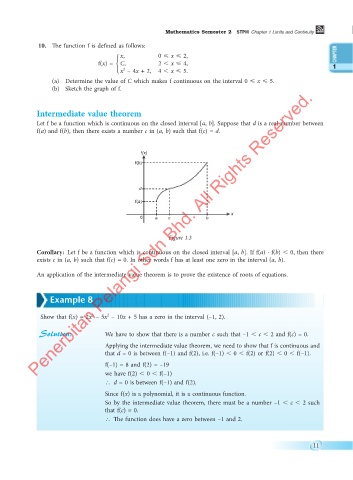
                Let f be a function which is continuous on the closed interval [a, b]. Suppose that d is a real number between
                f(a) and f(b), then there exists a number c in (a, b) such that f(c) = d.


                                                 f(x)
                                                f(b)


                                                 d

                                                f(a)
                                                                              x
                                                 0    a   c           b

                                                          Figure 1.3

                Corollary:  Let f be a function which is continuous on the closed interval [a, b]. If f(a) · f(b) , 0, then there
                exists c in (a, b) such that f(c) = 0. In other words f has at least one zero in the interval (a, b).

                An application of the intermediate value theorem is to prove the existence of roots of equations.


                     Example 8


                                       2
                                  3
                  Show that f(x) = 2x  – 5x  – 10x + 5 has a zero in the interval (–1, 2).
                  Solution:           We have to show that there is a number c such that –1 , c , 2 and f(c) = 0.

                                      Applying the intermediate value theorem, we need to show that f is continuous and
                                      that d = 0 is between f(–1) and f(2), i.e. f(–1) , 0 , f(2) or f(2) , 0 , f(–1).
                                      f(–1) = 8 and f(2) = –19
                                      we have f(2) , 0 , f(–1)
                                      \  d = 0 is between f(–1) and f(2).
                                      Since f(x) is a polynomial, it is a continuous function.
                                      So by the intermediate value theorem, there must be a number –1 ,  c , 2 such
                                      that f(c) = 0.
                                      \  The function does have a zero between –1 and 2.


                                                                                                        11


         01 STPM Math(T) T2.indd   11                                                                  28/01/2022   5:30 PM

