


Page 6 - Focus PT3 2020 Science ( BI Version )
P. 6
Science PT3  Chapter 2  Cell as the Basic Unit of Life

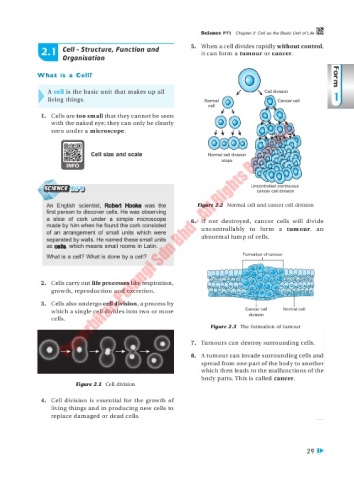
              2.1    Cell – Structure, Function and           5.  When a cell divides rapidly without control,
                                                                 it can form a tumour or cancer.
                     Organisation

             What is a Cell?                                                                   Form        Form


                A cell is the basic unit that makes up all                           Cell division
                living things.                                    Normal                 Cancer cell       1
                                                                   cell
               1.  Cells are too small that they cannot be seen
                 with the naked eye; they can only be clearly
                 seen under a microscope.


                              Cell size and scale                  Normal cell division
                                                                       stops
                      INFO


                  E
                   N
                  E
                  E
                  E
                    C
                    C
                     E
                     E
                    C
                   N
                   N
                    C
                   N
               SC
               SC
               SC
               SC
               SCIENCE INFO
               SC I I I I I E                           N C E  INFO              Uncontrolled continuous
                       INFO
               SCIENCE INFO
                       INFO
                       INFO
                     E INFO
                       INFO
                        INFO
                        INFO
                     E INFO
                        INFO
                        INFO
                        INFO
                                                                                  cancer cell division
                An English scientist,  Robert  Hooke was  the   Figure 2.2  Normal cell and cancer cell division
                first person to discover cells. He was observing
                a slice of cork under a simple microscope     6.  If  not destroyed, cancer cells will divide
                made by him when he found the cork consisted     uncontrollably to form a  tumour, an
                of an arrangement of small units which were
                separated by walls. He named these small units   abnormal lump of cells.
                as cells, which means small rooms in Latin.
                What is a cell? What is done by a cell?                       Formation of tumour
               2.  Cells carry out life processes like respiration,
                 growth, reproduction and excretion.
               3.  Cells also undergo cell division, a process by
                 which a single cell divides into two or more                  Cancer cell  Normal cell
                 cells.                                                         division
                                                                    Figure 2.3  The formation of tumour
                                                              7.  Tumours can destroy surrounding cells.
                                                              8.  A tumour can invade surrounding cells and
                                                                 spread from one part of the body to another
                                                                 which then leads to the malfunctions of the
                                                                 body parts. This is called cancer.
                         Figure 2.1  Cell division
               4.  Cell division is essential for the growth of
                 living things and in producing new cells to
                 replace damaged or dead cells.
                                                                                                  29


     02 Fokus Science F1.indd   29                                                                  11/19/19   11:41 AM

