


Page 10 - Focus PT3 2020 Science ( BI Version )
P. 10
Science PT3  Chapter 2  Cell as the Basic Unit of Life
             Functions of Structures in Animal Cells and
             Plant Cells                                                 Common Error

               1.  There are many similarities and differences between     All plant cells contain chloroplasts.
                 animal cells and plant cells.                              Not all plant cells have   Form  Form
                                                                           chloroplasts. For example, the
               2.  Both cells have a nucleus, cytoplasm, cell membrane     epidermal cells of an onion
                 and mitochondria.                                         bulb which do not carry out     1
                                                                           photosynthesis do not contain
               3.  Plant cells have a cell wall, chloroplasts and vacuole.  chloroplasts.
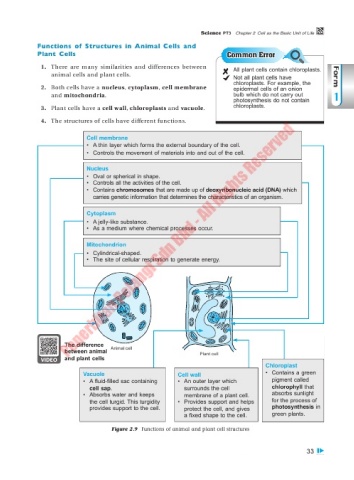
               4.  The structures of cells have different functions.


                             Cell membrane
                             •  A thin layer which forms the external boundary of the cell.
                             •  Controls the movement of materials into and out of the cell.

                             Nucleus
                             •  Oval or spherical in shape.
                             •  Controls all the activities of the cell.
                             •  Contains chromosomes that are made up of deoxyribonucleic acid (DNA) which
                               carries genetic information that determines the characteristics of an organism.


                             Cytoplasm
                             •  A jelly-like substance.
                             •  As a medium where chemical processes occur.


                             Mitochondrion
                             •  Cylindrical-shaped.
                             •  The site of cellular respiration to generate energy.


                      The difference
                      between animal   Animal cell              Plant cell
              VIDEO   and plant cells
                                                                                     Chloroplast
                           Vacuole                       Cell wall                   •  Contains a green
                           •  A fluid-filled sac containing   •  An outer layer which   pigment called
                             cell sap.                     surrounds the cell          chlorophyll that
                           •  Absorbs water and keeps      membrane of a plant cell.   absorbs sunlight
                             the cell turgid. This turgidity   •  Provides support and helps   for the process of
                             provides support to the cell.  protect the cell, and gives   photosynthesis in
                                                           a fixed shape to the cell.  green plants.
                                    Figure 2.9  Functions of animal and plant cell structures


                                                                                                  33


     02 Fokus Science F1.indd   33                                                                  11/19/19   11:41 AM

