


Page 11 - Focus PT3 2020 Science ( BI Version )
P. 11
Science PT3  Chapter 2  Cell as the Basic Unit of Life
           Comparison between Animal Cells and Plant Cells


                         Animal cell                                           Plant cell
                                                    Similarities
                                                                Icon Focus KSSM Science form 1 English ver.
                               Both have a nucleus, cell membrane, cytoplasm and mitochondria
      Form
                  Form
      1
                                                    Differences
                   Does not have a cell wall         Cell wall        Has a cell wall made of cellulose
                                                                                          Plural
                   Does not have chloroplast       Chloroplast     Has chloroplasts that contain chlorophyll
            Usually absent, but if present, the vacuoles   Vacuole    Has one or a few large vacuoles
                    are small and scattered
                 Does not have a fixed shape         Shape                  Has a fixed shape

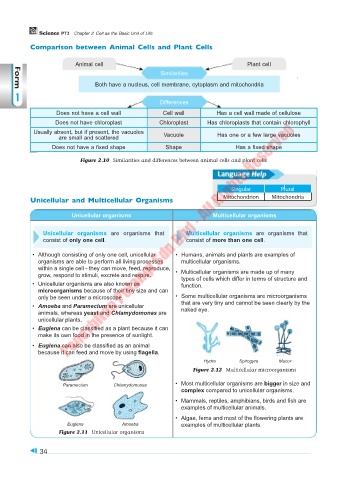
                          Figure 2.10  Similarities and differences between animal cells and plant cells


                                                                          Singular        Plural
                                                                                          Plural
           Unicellular and Multicellular Organisms                      Mitochondrion  Mitochondria

                        Unicellular organisms                       Multicellular organisms

               Unicellular organisms  are organisms that    Multicellular organisms  are organisms that
               consist of only one cell.                    consist of more than one cell.

           •  Although consisting of only one cell, unicellular   •  Humans, animals and plants are examples of
             organisms are able to perform all living processes   multicellular organisms.
             within a single cell - they can move, feed, reproduce,   •  Multicellular organisms are made up of many
             grow, respond to stimuli, excrete and respire.  types of cells which differ in terms of structure and
           •  Unicellular organisms are also known as     function.
             microorganisms because of their tiny size and can
             only be seen under a microscope.            •  Some multicellular organisms are microorganisms
           •  Amoeba and Paramecium are unicellular       that are very tiny and cannot be seen clearly by the
             animals, whereas yeast and Chlamydomonas are   naked eye.
             unicellular plants.
           •  Euglena can be classified as a plant because it can
             make its own food in the presence of sunlight.
           •  Euglena can also be classified as an animal
             because it can feed and move by using flagella.
                                                                  Hydra      Spirogyra   Mucor
                                                              Figure 2.12  Multicellular microorganisms


                     Paramecium      Chlamydomonas       •  Most multicellular organisms are bigger in size and
                                                          complex compared to unicellular organisms.
                                                         •  Mammals, reptiles, amphibians, birds and fish are
                                                          examples of multicellular animals.
                                                         •  Algae, ferns and most of the flowering plants are
                      Euglena           Amoeba            examples of multicellular plants.
                    Figure 2.11  Unicellular organisms

              34


     02 Fokus Science F1.indd   34                                                                  11/19/19   11:41 AM

