


Page 8 - Cambridge IGCSE Mathematics Core and Extended
P. 8
11.1 Polygons


        A. Recognising polygons

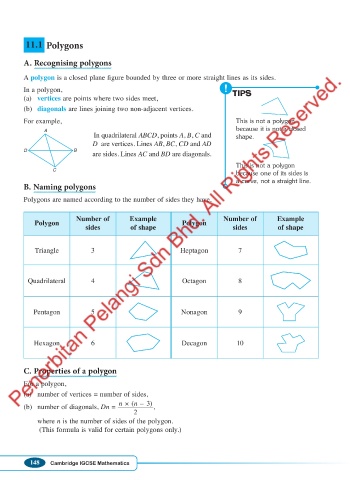
        A polygon is a closed plane figure bounded by three or more straight lines as its sides.

        In a polygon,                                                    TIPS
        (a)  vertices are points where two sides meet,
        (b)  diagonals are lines joining two  non- adjacent vertices.

        For example,                                                      This is not a polygon
                                                                          because it is not a closed
               A
                              In quadrilateral ABCD, points A, B, C and   shape.
                             D  are vertices. Lines AB, BC, CD and AD
        D               B
                             are sides. Lines AC and BD are diagonals.
                                                                          This is not a polygon
                 C
                                                                          because one of its sides is
                                                                          a curve, not a straight line.
        B. Naming polygons

        Polygons are named according to the number of sides they have.

                        Number of        Example                      Number of       Example
            Polygon                                      Polygon
                           sides         of shape                        sides         of shape


            Triangle         3                           Heptagon         7


          Quadrilateral      4                           Octagon          8


           Pentagon          5                           Nonagon          9


           Hexagon           6                           Decagon          10


        C. Properties of a polygon

        For a polygon,
        (a)  number of vertices = number of sides,
                                      n × (n – 3)
        (b)  number of diagonals, Dn =          ,
                                          2
            where n is the number of sides of the polygon.
             (This formula is valid for certain polygons only.)


          148    Cambridge IGCSE Mathematics


                                                                                                14/07/2022   10:14 AM
   DA1501_pg 147 to 161.indd   148                                                              14/07/2022   10:14 AM
   DA1501_pg 147 to 161.indd   148

