Page 12 - Cambridge IGCSE Mathematics Core and Extended
P. 12
11.3 Triangles

        A. Identifying triangles

                                                                                         P  Ve rtex
                                                                                            Vertex
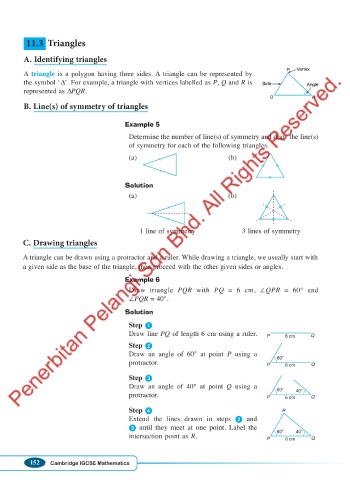
        A triangle is a polygon having three sides. A triangle can be  represented by
        the  symbol ‘∆’. For example, a triangle with vertices labelled as P, Q and R is   Side  Angle
                                                                                  Side
                                                                                               Angle
          represented as ∆PQR.
                                                                                    Q            R
        B. Line(s) of symmetry of triangles
                                       Example 5

                                         Determine the number of line(s) of symmetry and draw the line(s)
                                         of symmetry for each of the  following triangles.

                                         (a)                             (b)


                                       Solution
                                         (a)                           (b)


                                             1 line of symmetry            3 lines of symmetry
        C. Drawing triangles

        A triangle can be drawn using a protractor and a ruler. While drawing a triangle, we usually start with
        a given side as the base of the triangle, then proceed with the other given sides or angles.
                                       Example 6
                                         Draw  triangle  PQR  with  PQ  =  6  cm,  ∠QPR  =  60°  and
                                         ∠PQR = 40°.
                                       Solution

                                         Step 
                                         Draw line PQ of length 6 cm using a ruler.  P   6 cm    Q
                                         Step 2
                                         Draw  an  angle  of  60°  at  point  P  using  a
                                                                                      60°
                                           protractor.                             P     6 cm    Q

                                         Step 3
                                         Draw  an  angle  of  40°  at  point  Q  using  a
                                                                                      60°   40°
                                         protractor.                               P     6 cm    Q
                                         Step 4                                         R
                                         Extend  the  lines  drawn  in  steps  2 and
                                         3  until  they  meet  at  one  point.  Label  the
                                                                                      60°   40°
                                         intersection point as R.
                                                                                   P     6 cm    Q

          152    Cambridge IGCSE Mathematics


                                                                                                14/07/2022   10:14 AM
   DA1501_pg 147 to 161.indd   152                                                              14/07/2022   10:14 AM
   DA1501_pg 147 to 161.indd   152
   7   8   9   10   11   12   13   14   15   16   17