


Page 9 - Cambridge IGCSE Mathematics Core and Extended
P. 9
Example 1
                                                                           TIPS
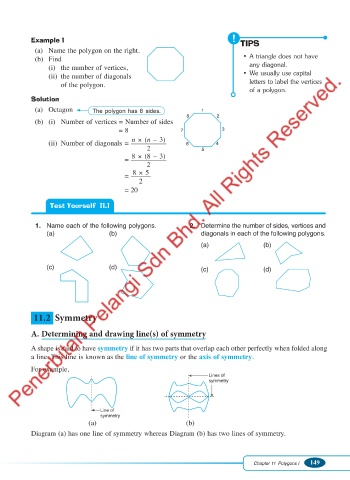
            (a)  Name the polygon on the right.
            (b)  Find                                                       • A triangle does not have
                (i)  the number of  vertices,                                 any diagonal.
                (ii)  the number of diagonals                               • We usually use capital
                    of the polygon.                                           letters to label the vertices
                                                                              of a polygon.
           Solution
            (a)  Octagon     The polygon has 8 sides.          1
                                                          8         2
            (b)  (i)  Number of vertices = Number of sides
                                      = 8                7           3
                                          n × (n – 3)
                (ii)  Number of diagonals =               6        4
                                              2                5
                                          8 × (8 – 3)
                                       =
                                              2
                                          8 × 5
                                       =
                                            2
                                       = 20

                Test Yourself  11.1


             1.  Name each of the following polygons.       2.  Determine the number of sides, vertices and
               (a)                 (b)                         diagonals in each of the following polygons.
                                                               (a)                (b)


               (c)                 (d)
                                                               (c)                (d)


           11.2 Symmetry

           A. Determining and drawing line(s) of symmetry

           A shape is said to have symmetry if it has two parts that overlap each other perfectly when folded along
           a line. This line is known as the line of symmetry or the axis of symmetry.
           For example,
                                                                 Lines of
                                                                 symmetry


                                Line of
                                symmetry
                              (a)                           (b)

           Diagram (a) has one line of symmetry whereas Diagram (b) has two lines of symmetry.


                                                                               Chapter 11  Polygons I   149


                                                                                                14/07/2022   10:14 AM
   DA1501_pg 147 to 161.indd   149
   DA1501_pg 147 to 161.indd   149                                                              14/07/2022   10:14 AM

