Page 32 - Ranger SPM 2022 - Additional Mathematics
P. 32
Additional Mathematics  SPM  Chapter 2 Differentiation

                      2.4    Application of Differentiation
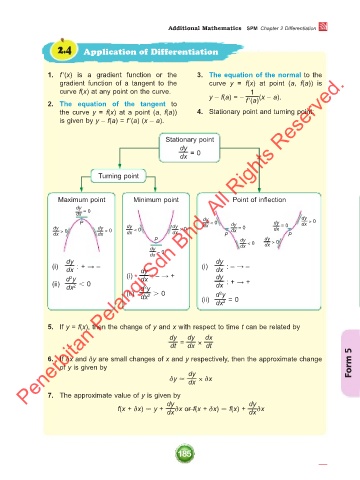
                   Turning point


             Penerbitan Pelangi Sdn Bhd. All Rights Reserved.
                    1.  f ʹ(x) is a gradient  function or the     3.  The equation of the normal to the
                      gradient function of a tangent  to the   curve  y =  f(x) at point (a,  f(a)) is
                      curve f(x) at any point on the curve.               1
                                                               y – f(a) = –   f ʹ(a) (x – a).
                    2.  The equation of the tangent to
                      the curve  y =  f(x) at a point (a,  f(a))       4.  Stationary point and turning point:
                      is given by y – f(a) = f ʹ(a) (x – a).

                                                   Stationary point
                                                       dy
                                                       dx  = 0

                                 Turning point


                      Maximum point       Minimum point               Point of inflection
                           dy
                           dx  = 0
                                                             dy                         dy
                            P                                dx  < 0  dy         dy  = 0  dx  > 0
                    dy  > 0      dy  < 0  dy  < 0    dy  > 0         dx  = 0     dx
                    dx           dx      dx          dx            P                 P
                                                P                       dy  < 0  dy  > 0
                                               dy                       dx     dx
                                               dx  = 0
                        dy                                       dy
                    (i)   dx  : + → –       dy               (i)   dx  : – → –
                        d y             (i)   dx  : – → +        dy
                         2
                    (ii)   2   0                                dx  : + → +
                        dx                  d y
                                             2
                                        (ii)   dx 2   0     (ii)   d y 2  = 0
                                                                  2
                                                                 dx
                    5.  If y = f(x), then the change of y and x with respect to time t can be related by
                                                    dy   dy   dx
                                                    dt   =   dx  ×   dt

                    6.  If δx and δy are small changes of x and y respectively, then the approximate change
                      of y is given by                                                                Form 5
                                                         dy
                                                    δy   dx  × δx

                    7.  The approximate value of y is given by
                                                    dy                    dy
                                      f(x + δx)  y +  dx δx or f(x + δx)  f(x) +  dx  δx


                                                      185


         02 Ranger Mate Tambahan Tg5.indd   185                                             25/02/2022   9:23 AM
   27   28   29   30   31   32   33   34   35   36   37