


Page 11 - The Design Thinking Playbook
P. 11
Introduction


        Where will the next major market

        opportunities emerge?


           Here  Here   Here   Here    Here   Here      The old management paradigms must therefore be dissolved. But they will dissolve only when we allow
                                                        new forms of collaboration, apply different mindsets, and create more room to develop and find solutions.

                                                                           What are the three things that are important to us?


                                                                                  1)  Keep your personality!

                                                                      “No one needs to mutate into Karl Lagerfeld just because we have
                          Done!
                                                                          creativity and room for development at our disposal!”
        The hunt for the next big market opportunity is ever present. Most of
        us are ambitious company founders and good employees, managers,
        product designers, lecturers, or even professors. We all had cool
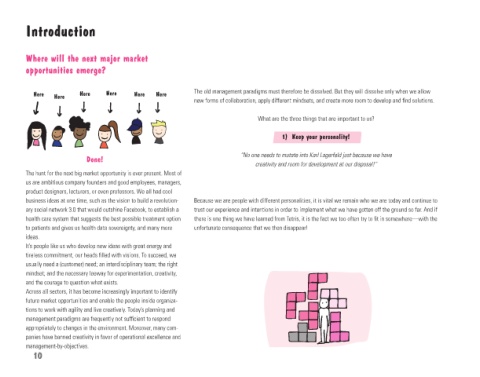
        business ideas at one time, such as the vision to build a revolution-  Because we are people with different personalities, it is vital we remain who we are today and continue to
        ary social network 3.0 that would outshine Facebook, to establish a   trust our experience and intentions in order to implement what we have gotten off the ground so far. And if
        health care system that suggests the best possible treatment option   there is one thing we have learned from Tetris, it is the fact we too often try to fit in somewhere—with the
        to patients and gives us health data sovereignty, and many more   unfortunate consequence that we then disappear!
        ideas.
        It’s people like us who develop new ideas with great energy and
        tireless commitment, our heads filled with visions. To succeed, we
        usually need a (customer) need; an interdisciplinary team; the right
        mindset; and the necessary leeway for experimentation, creativity,
        and the courage to question what exists.
        Across all sectors, it has become increasingly important to identify
        future market opportunities and enable the people inside organiza-
        tions to work with agility and live creatively. Today’s planning and
        management paradigms are frequently not sufficient to respond
        appropriately to changes in the environment. Moreover, many com-
        panies have banned creativity in favor of operational excellence and
        management-by-objectives.
           10

