


Page 13 - The Design Thinking Playbook
P. 13
What should you expect?

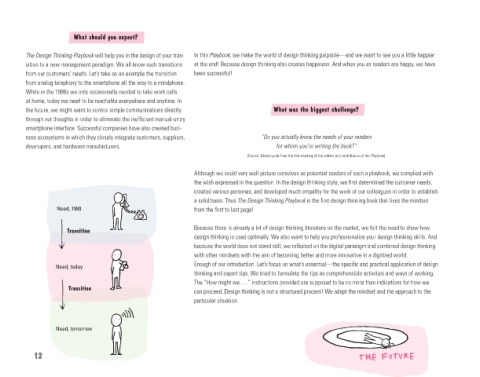
        The Design Thinking Playbook will help you in the design of your tran-  In this Playbook, we make the world of design thinking palpable—and we want to see you a little happier
        sition to a new management paradigm. We all know such transitions   at the end! Because design thinking also creates happiness. And when you as readers are happy, we have
        from our customers’ needs. Let’s take as an example the transition   been successful!
        from analog telephony to the smartphone all the way to a mindphone.
        While in the 1980s we only occasionally needed to take work calls
        at home, today we need to be reachable everywhere and anytime. In
        the future, we might want to control simple communications directly    What was the biggest challenge?
        through our thoughts in order to eliminate the inefficient manual-entry
        smartphone interface. Successful companies have also created busi-
        ness ecosystems in which they closely integrate customers, suppliers,   “Do you actually know the needs of your readers
        developers, and hardware manufacturers.                                 for whom you’re writing the book?”
                                                                        (Source: Direct quote from the first meeting of the editors and contributors of the Playbook)

                                                        Although we could very well picture ourselves as potential readers of such a playbook, we complied with
                                                        the wish expressed in the question. In the design thinking style, we first determined the customer needs,
                                                        created various personas, and developed much empathy for the work of our colleagues in order to establish
                                                        a solid basis. Thus The Design Thinking Playbook is the first design thinking book that lives the mindset
                 Need, 1980                             from the first to last page!

                    Transition                          Because there is already a lot of design thinking literature on the market, we felt the need to show how
                                                        design thinking is used optimally. We also want to help you professionalize your design thinking skills. And
                                                        because the world does not stand still, we reflected on the digital paradigm and combined design thinking
                                                        with other mindsets with the aim of becoming better and more innovative in a digitized world.
                 Need, today                            Enough of our introduction. Let’s focus on what’s essential—the specific and practical application of design
                                                        thinking and expert tips. We tried to formulate the tips as comprehensible activities and ways of working.
                                                        The “How might we . . .” instructions provided are supposed to be no more than indications for how we
                     Transition
                                                        can proceed. Design thinking is not a structured process! We adapt the mindset and the approach to the
                                                        particular situation.


                 Need, tomorrow


           12

