


Page 29 - The Design Thinking Playbook
P. 29
EXPERT TIP
                     Empathy map


        How do we build up empathy with a potential user?

        The initial draft of a persona is quickly done. Although just an outline   After this “adventure,” it is useful to define hypotheses on the team, then test them with a potential user
        exists, it can be quite helpful and eye-opening. A brainstorming on the   or by using existing data, then confirm, discard, or adapt them. The picture of the persona becomes clearer
        team can yield initial insights and contribute to a better understand-  and more solid with each iteration.
        ing; it is absolutely necessary, though, that it be underpinned with
        real people, observations, and interviews.
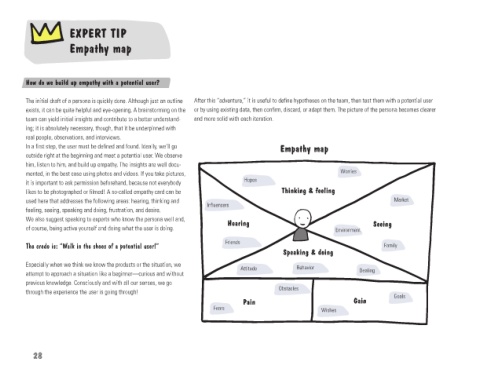
        In a first step, the user must be defined and found. Ideally, we’ll go   Empathy map
        outside right at the beginning and meet a potential user. We observe
        him, listen to him, and build up empathy. The insights are well docu-
        mented, in the best case using photos and videos. If you take pictures,                   Worries
        it is important to ask permission beforehand, because not everybody   Hopes
        likes to be photographed or filmed! A so-called empathy card can be       Thinking & feeling
        used here that addresses the following areas: hearing, thinking and   Influencers                         Market
        feeling, seeing, speaking and doing, frustration, and desire.
        We also suggest speaking to experts who know the persona well and,   Hearing
        of course, being active yourself and doing what the user is doing.                       Environment  Seeing

        The credo is: “Walk in the shoes of a potential user!”   Friends                                       Family
                                                                                  Speaking & doing

        Especially when we think we know the products or the situation, we
                                                                      Attitude        Behavior          Dealing
        attempt to approach a situation like a beginner—curious and without
        previous knowledge. Consciously and with all our senses, we go
        through the experience the user is going through!                        Obstacles                        Goals
                                                                      Pain                            Gain
                                                              Fears                          Wishes


          28

