


Page 70 - The Design Thinking Playbook
P. 70
EXPERT TIP
                       The 6 WH questions


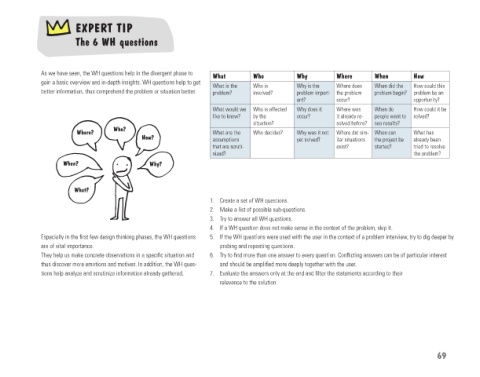
             As we have seen, the WH questions help in the divergent phase to   What  Who  Why   Where      When       How
             gain a basic overview and in-depth insights. WH questions help to get   What is the   Who is   Why is the   Where does   When did the   How could this
             better information, thus comprehend the problem or situation better.   problem?  involved?  problem import-  the problem   problem begin?  problem be an
                                                                                      ant?       occur?                opportunity?
                                                              What would we  Who is affected  Why does it   Where was   When do   How could it be
                                                              like to know?  by the   occur?     it already re-  people want to   solved?
                                                                         situation?              solved before?  see results?
                                 Who?
                       Where?                                 What are the   Who decides?  Why was it not   Where did sim- When can   What has
                                          How?                assumptions             yet solved?  ilar situations   the project be   already been
                                                              that are scruti-                   exist?     started?   tried to resolve
                                                              nized?                                                   the problem?
                   When?                    Why?


                      What?
                                                             1.  Create a set of WH questions.
                                                             2.  Make a list of possible sub-questions.
                                                             3.  Try to answer all WH questions.
                                                             4.  If a WH question does not make sense in the context of the problem, skip it.
             Especially in the first few design thinking phases, the WH questions   5.  If the WH questions were used with the user in the context of a problem interview, try to dig deeper by
             are of vital importance.                           probing and repeating questions.
             They help us make concrete observations in a specific situation and   6.  Try to find more than one answer to every question. Conflicting answers can be of particular interest
             thus discover more emotions and motives. In addition, the WH ques-     and should be amplified more deeply together with the user.
             tions help analyze and scrutinize information already gathered.  7.  Evaluate the answers only at the end and filter the statements according to their
                                                                relevance to the solution.


                                                                                                                              69

