


Page 71 - The Design Thinking Playbook
P. 71
HOW MIGHT WE...

                  reflect on our own behavior and
                  assumptions?


        The task now is to reflect on what we have heard and seen as well   After having expanded the perspective on a topic, we can now go
        as our own behavior. This transition helps to improve the process   back to ideation. We iterate our original solution based on interac-
        continuously.                                   tions with the potential users. An iteration means to improve some-
                                                        thing in an existing idea or to build a completely new prototype.
        The reflection proceeds along three steps:
                                                        Third step: Were our approach and the kind of questions
        First step: Reflect upon the user and the need.   right?
        What have we learned in relation to the project?  In a final step, we check whether our approach was right. Did the way
        We ask ourselves these project-related questions:  we posed our questions come across well? Was our documentation
                                                        of any use later? This way, we see what was good, where we should
        •   How do people think and act in everyday life?  improve things, and what we still should try out.
        •   What is done differently than we imagined?
        •   What surprises us (“Eureka!” moments)?
        •   Is there a need that is worth being solved?

        Second step: Is our solution the right one?
        In a second step, we check whether our solution feels right. Is it really
        true that we don’t have to change anything for our idea to work in
        everyday life? What would we change so that our innovation is used
        in everyday life?
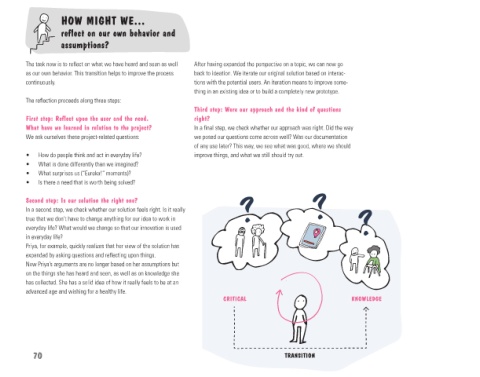
        Priya, for example, quickly realizes that her view of the solution has
        expanded by asking questions and reflecting upon things.
        Now Priya’s arguments are no longer based on her assumptions but
        on the things she has heard and seen, as well as on knowledge she
        has collected. She has a solid idea of how it really feels to be at an
        advanced age and wishing for a healthy life.
                                                                 CRITICAL                            KNOWLEDGE


           70                                                                     TRANSITION

