


Page 29 - English Lesson Plan Year 3
P. 29
Primary Year 3 SK Scheme of Work
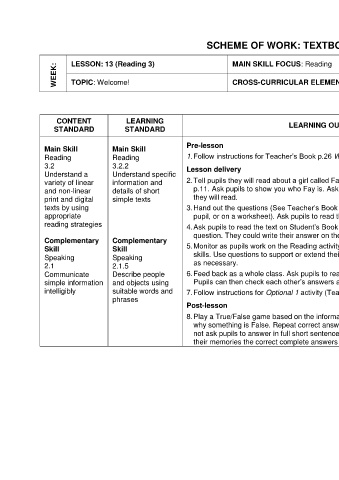
                                                    SCHEME OF WORK: TEXTBOOK BASED LESSON (Unit 1)
                   LESSON: 13 (Reading 3)                  MAIN SKILL FOCUS: Reading                    THEME: World of Self, Family and Friends
               WEEK:   TOPIC: Welcome!                     CROSS-CURRICULAR ELEMENT: Language           LANGUAGE/GRAMMAR FOCUS: Review of Unit 1 language


               CONTENT          LEARNING                                                                                 MATERIALS /         DIFFERENTIATION
              STANDARD          STANDARD                                 LEARNING OUTLINE                               REFERENCES             STRATEGIES

            Main Skill       Main Skill        Pre-lesson                                                             Get Smart plus 3   Differentiate learning
            Reading          Reading           1. Follow instructions for Teacher’s Book p.26 Warm up.                Student’s Book p.11   according to the needs of your
            3.2              3.2.2             Lesson delivery                                                        Activity 1         pupils and class. Please see
            Understand a     Understand specific                                                                                         the seven differentiation
            variety of linear   information and   2. Tell pupils they will read about a girl called Fay. Show the picture on Student’s Book   Teacher’s Book   strategies listed in the
            and non-linear   details of short    p.11. Ask pupils to show you who Fay is. Ask questions to help pupils predict what   p.26–7   introduction. Please also
                                                                                                                                         consider the following:
            print and digital   simple texts     they will read.                                                      Family photos (from
            texts by using                     3. Hand out the questions (See Teacher’s Book p.26) cut into strips, one for each   you and your pupils)  Ask different prediction
            appropriate                          pupil, or on a worksheet). Ask pupils to read their question.                           questions to different pupils,
            reading strategies                 4. Ask pupils to read the text on Student’s Book p.11 and find the answer to their   Questions   depending on their level of
                                                 question. They could write their answer on the paper or in their notebook.   worksheet/strips,   proficiency. Some may be
            Complementary    Complementary                                                                            from Teacher’s     closed questions, others open
            Skill            Skill             5. Monitor as pupils work on the Reading activity to get an idea of individuals’ Reading   Book p.26   questions.
            Speaking         Speaking            skills. Use questions to support or extend their understanding. Make notes on pupils
            2.1              2.1.5               as necessary.                                                                           You could give more than one
            Communicate      Describe people   6. Feed back as a whole class. Ask pupils to read their question then give the answer.    question to some pupils to
            simple information  and objects using   Pupils can then check each other’s answers as they listen.                           answer.
            intelligibly     suitable words and   7. Follow instructions for Optional 1 activity (Teacher’s Book p.27).                  Plan which pupils will answer
                             phrases                                                                                                     questions during feedback to
                                               Post-lesson                                                                               help showcase pupils who
                                               8. Play a True/False game based on the information in the text. Ask pupils to explain     have worked hard.
                                                 why something is False. Repeat correct answers in complete short sentences. Do
                                                 not ask pupils to answer in full short sentences; at this point, just let them register in
                                                 their memories the correct complete answers from you.


                                                                                                                                                              42

