


Page 307 - English Lesson Plan Year 3
P. 307
Primary Year 3 SK Scheme of Work
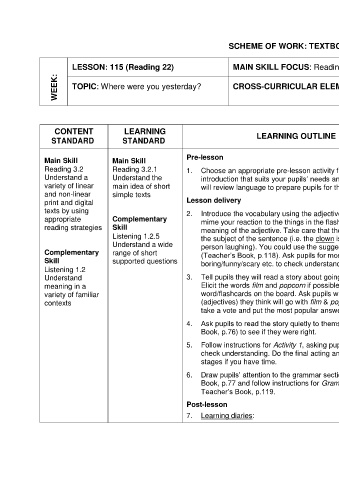
                                                          SCHEME OF WORK: TEXTBOOK BASED LESSON (Unit 8)

                   LESSON: 115 (Reading 22)                MAIN SKILL FOCUS: Reading                    THEME: World of self, family and friends
               WEEK:   TOPIC: Where were you yesterday?    CROSS-CURRICULAR ELEMENT: Language           LANGUAGE/GRAMMAR FOCUS: Adjectives, past

                                                                                                        simple statements & Yes/No questions (was/were)


               CONTENT          LEARNING                                                                   MATERIALS /              DIFFERENTIATION
              STANDARD         STANDARD                          LEARNING OUTLINE                          REFERENCES                 STRATEGIES

            Main Skill       Main Skill        Pre-lesson                                               Get Smart plus 3     Differentiate learning according to the
            Reading 3.2      Reading 3.2.1     1.  Choose an appropriate pre-lesson activity from the list in the   Student’s Book, p.76–   needs of your pupils and class.
            Understand a     Understand the        introduction that suits your pupils’ needs and interests and that   77    Please see the seven differentiation
            variety of linear   main idea of short   will review language to prepare pupils for the lesson.                  strategies listed in the introduction.
            and non-linear   simple texts                                                               Teacher’s Book, p.118–   Please also consider the following:
            print and digital                  Lesson delivery                                          119                  If you think the key vocabulary is
            texts by using                     2.  Introduce the vocabulary using the adjective flashcards; also,   Adjectives flashcards:   familiar to pupils, you could use word
            appropriate      Complementary         mime your reaction to the things in the flashcards to show the   something that is: scary   cards. If it is new, then use picture
            reading strategies   Skill             meaning of the adjective. Take care that the pupils understand   (e.g. an old house),   flashcards. If pupils are not familiar
                             Listening 1.2.5       the subject of the sentence (i.e. the clown is funny, not the   funny (e.g. a clown),   with popcorn, you may need to
                             Understand a wide     person laughing). You could use the suggestions in Warm up   delicious (e.g. a cake),   explain that people often eat this at
            Complementary    range of short        (Teacher’s Book, p.118). Ask pupils for more things they find   boring (e.g. a person   the cinema in some countries.
            Skill            supported questions   boring/funny/scary etc. to check understanding).     looking bored in front of
            Listening 1.2                                                                               the TV – note it is the   Ask different pupils different questions
            Understand                         3.  Tell pupils they will read a story about going to the cinema.   TV that is boring)   to check understanding. Try to ask all
            meaning in a                           Elicit the words film and popcorn if possible, and put the                pupils at least one question, if
            variety of familiar                    word/flashcards on the board. Ask pupils which words   Flashcards or word   possible with your class size.
            contexts                               (adjectives) they think will go with film & popcorn. You could   cards of film and
                                                   take a vote and put the most popular answer on the board.   popcorn
                                               4.  Ask pupils to read the story quietly to themselves (Student’s
                                                   Book, p.76) to see if they were right.
                                               5.  Follow instructions for Activity 1, asking pupils questions to
                                                   check understanding. Do the final acting and performance
                                                   stages if you have time.

                                               6.  Draw pupils’ attention to the grammar section on Student’s
                                                   Book, p.77 and follow instructions for Grammar Box on
                                                   Teacher’s Book, p.119.
                                               Post-lesson
                                               7.  Learning diaries:


                                                                                                                                                        186

