


Page 358 - English Lesson Plan Year 3
P. 358
Primary Year 3 SK Scheme of Work
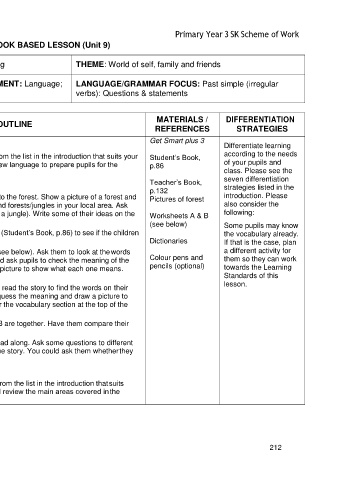
 SCHEME OF WORK: TEXTBOOK BASED LESSON (Unit 9)

 LESSON: 131 (Reading 25)   MAIN SKILL FOCUS: Reading   THEME: World of self, family and friends
 WEEK:   TOPIC: On holiday   CROSS-CURRICULAR ELEMENT: Language;   LANGUAGE/GRAMMAR FOCUS: Past simple (irregular

                    verbs): Questions & statements
 Environmental Sustainability


 CONTENT   LEARNING                     MATERIALS /      DIFFERENTIATION
 STANDARD   STANDARD   LEARNING OUTLINE   REFERENCES        STRATEGIES
                                      Get Smart plus 3
 Main Skill   Main Skill   Pre-lesson                    Differentiate learning
 Reading 3.2   Reading 3.2.3   1.  Choose an appropriate pre-lesson activity from the list in the introduction that suits your   Student’s Book,   according to the needs
 Understand a   Guess the   pupils’ needs and interests and that will review language to prepare pupils for the   p.86   of your pupils and
 variety of linear   meaning of   lesson.                class. Please see the
 and non-linear   unfamiliar words   Lesson delivery   Teacher’s Book,   seven differentiation
 print and digital   from clues       p.132              strategies listed in the
 texts by using   provided by   2.  Tell pupils they will read a story about a trip to the forest. Show a picture of a forest and   Pictures of forest   introduction. Please
 appropriate   visuals and the   elicit some differences between the forest and forests/jungles in your local area. Ask      also consider the
 reading strategies   topic   pupils what they might do in a forest (and/or a jungle). Write some of their ideas on the   Worksheets A & B   following:
       board.                         (see below)        Some pupils may know
       3.  Ask pupils to look at the pictures in the story (Student’s Book, p.86) to see if the children     the vocabulary already.
 Complementary   Complementary   in the story did any of the same things.   Dictionaries   If that is the case, plan
 Skill   Skill   4.  Give pairs of pupils the A or B worksheets (see below). Ask them to look at the words      a different activity for
 Reading 3.2   Reading 3.2.4   on their worksheet. Hand out dictionaries and ask pupils to check the meaning of the   Colour pens and   them so they can work
 Understand a   Recognise and   words in the dictionary. They should draw a picture to show what each one means.   pencils (optional)   towards the Learning
 variety of linear   use with support   Pupils can work in pairs for this activity.   Standards of this
 and non-linear   key features of a                      lesson.
 print and digital   simple   5.  For the second part of the worksheet, pupils read the story to find the words on their
 texts by using   monolingual   worksheet. Then they work in their pairs to guess the meaning and draw a picture to
 appropriate   dictionary   show their understanding. Ask them to cover the vocabulary section at the top of the
 reading strategies   page.
 6.  Change pupil pairs so that A and A / B and B are together. Have them compare their
 pictures to see if they drew the same things.
 7.  Play the CD of the story and ask pupils to read along. Ask some questions to different
 pupils to check that they have understood the story. You could ask them whether they
 have experience of doing these things.
 Post-lesson
 8.  Choose an appropriate post-lesson activity from the list in the introduction that suits
 your pupils’ needs and interests and that will review the main areas covered in the
 lesson.


                                                                    212

