


Page 363 - English Lesson Plan Year 3
P. 363
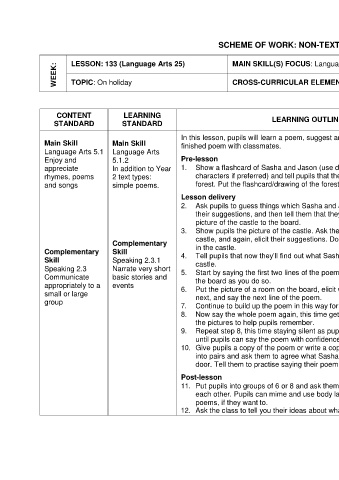
Primary Year 3 SK Scheme of Work
                                                       SCHEME OF WORK: NON-TEXTBOOK BASED LESSON (Unit 9)

               WEEK:   LESSON: 133 (Language Arts 25)      MAIN SKILL(S) FOCUS: Language Arts           THEME: World of Stories

                   TOPIC: On holiday
                                                           CROSS-CURRICULAR ELEMENT: Language
                                                                                                        LANGUAGE/GRAMMAR FOCUS: Past simple: went, was …


               CONTENT          LEARNING                                                                         MATERIALS /
              STANDARD         STANDARD                              LEARNING OUTLINE                           REFERENCES       DIFFERENTIATION STRATEGIES
                                              In this lesson, pupils will learn a poem, suggest an ending, and share their
            Main Skill       Main Skill       finished poem with classmates.                                   Flashcards or    Differentiate learning according to
            Language Arts 5.1  Language Arts                                                                   drawings of a boy   the needs of your pupils and class.
            Enjoy and        5.1.2            Pre-lesson                                                       and a girl, a    Please see the seven differentiation
            appreciate       In addition to Year   1.  Show a flashcard of Sasha and Jason (use different names for the   forest, castle,   strategies listed in the introduction
            rhymes, poems    2 text types:        characters if preferred) and tell pupils that they went on holiday in a big   room, box, key,
            and songs        simple poems.        forest. Put the flashcard/drawing of the forest on the board.   door.
                                              Lesson delivery
                                              2.  Ask pupils to guess things which Sasha and Jason saw in the forest. Elicit      Copy of Sasha
                                                  their suggestions, and then tell them that they saw a castle. Add your   and Jason went
                                                  picture of the castle to the board.                          on holiday poem
                                              3.  Show pupils the picture of the castle. Ask them to guess what was in the
                             Complementary        castle, and again, elicit their suggestions. Don’t tell pupils what was really
                                                  in the castle.
            Complementary    Skill            4.  Tell pupils that now they’ll find out what Sasha and Jason really saw in the
            Skill            Speaking 2.3.1       castle.
            Speaking 2.3     Narrate very short   5.  Start by saying the first two lines of the poem, pointing to the pictures on
            Communicate      basic stories and    the board as you do so.
            appropriately to a   events       6.  Put the picture of a room on the board, elicit what Sasha and Jason saw
            small or large                        next, and say the next line of the poem.
            group
                                              7.  Continue to build up the poem in this way for each new line until the end.
                                              8.  Now say the whole poem again, this time getting pupils to join in. Point to
                                                  the pictures to help pupils remember.
                                              9.  Repeat step 8, this time staying silent as pupils say the poem, Continue
                                                  until pupils can say the poem with confidence
                                              10.  Give pupils a copy of the poem or write a copy on the board. Put pupils
                                                  into pairs and ask them to agree what Sasha and Jason saw behind the
                                                  door. Tell them to practise saying their poem together.
                                              Post-lesson
                                              11.  Put pupils into groups of 6 or 8 and ask them to perform their poems to
                                                  each other. Pupils can mime and use body language as they perform their
                                                  poems, if they want to.
                                              12.  Ask the class to tell you their ideas about what Sasha and Jason saw.


                                                                                                                                                        216

