


Page 58 - English Lesson Plan Year 3
P. 58
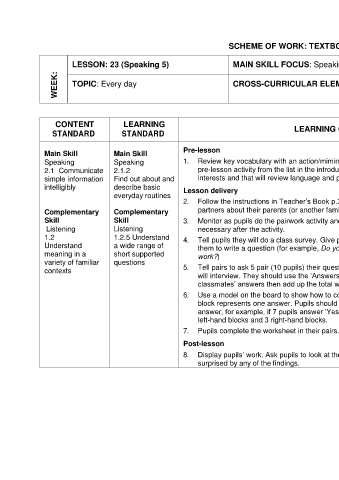
Primary Year 3 SK Scheme of Work
                                                          SCHEME OF WORK: TEXTBOOK BASED LESSON (Unit 2)

                   LESSON: 23 (Speaking 5)                 MAIN SKILL FOCUS: Speaking                   THEME: World of Self, Family and Friends
               WEEK:   TOPIC: Every day                    CROSS-CURRICULAR ELEMENT: Language           LANGUAGE/GRAMMAR FOCUS: Present simple Yes/No

                                                                                                        questions


               CONTENT          LEARNING                                                                                    MATERIALS /      DIFFERENTIATION
              STANDARD         STANDARD                                   LEARNING OUTLINE                                  REFERENCES         STRATEGIES
                                                                                                                            Get Smart plus 3
            Main Skill       Main Skill        Pre-lesson                                                                                  Differentiate learning
            Speaking         Speaking          1.  Review key vocabulary with an action/miming game, or you could choose an appropriate   Student’s Book   according to the needs of
            2.1  Communicate   2.1.2              pre-lesson activity from the list in the introduction that suits your pupils’ needs and   p.17   your pupils and class.
            simple information   Find out about and   interests and that will review language and prepare pupils for the lesson.           Please see the seven
            intelligibly     describe basic    Lesson delivery                                                              Teacher’s Book   differentiation strategies
                             everyday routines                                                                              p.35           listed in the introduction.
                                               2.  Follow the instructions in Teacher’s Book p.35 for Activity 4. Have pupils ask their      Please also consider the
            Complementary    Complementary        partners about their parents (or another family member, as appropriate to your pupils).   Class survey   following:
            Skill            Skill             3.  Monitor as pupils do the pairwork activity and review the question-answer form if   worksheet (see   For extra practice, pupils
             Listening       Listening            necessary after the activity.                                             below for      can ask more
            1.2              1.2.5 Understand   4.  Tell pupils they will do a class survey. Give pupils the worksheet (one per pair) and ask   example)   classmates.
            Understand       a wide range of      them to write a question (for example, Do you … to school? or Does your dad/mum … to
            meaning in a     short supported      work?)                                                                                   Fast finishers or more
            variety of familiar   questions                                                                                                proficient pairs of pupils
            contexts                           5.  Tell pairs to ask 5 pair (10 pupils) their question and write yes or no for each pupil they   could ask more than one
                                                  will interview. They should use the ‘Answers’ boxes on the worksheet to keep count of    question. You will need
                                                  classmates’ answers then add up the total when they have finished.                       extra worksheets for
                                               6.  Use a model on the board to show how to complete the chart on the worksheet. Each       them.
                                                  block represents one answer. Pupils should colour the number of squares for each
                                                  answer, for example, if 7 pupils answer ‘Yes’ and 3 pupils answer ‘No’, then they colour 7
                                                  left-hand blocks and 3 right-hand blocks.
                                               7.  Pupils complete the worksheet in their pairs.
                                               Post-lesson
                                               8.  Display pupils’ work. Ask pupils to look at the questions and charts and tell you if they are
                                                  surprised by any of the findings.


                                                                                                                                                         58

